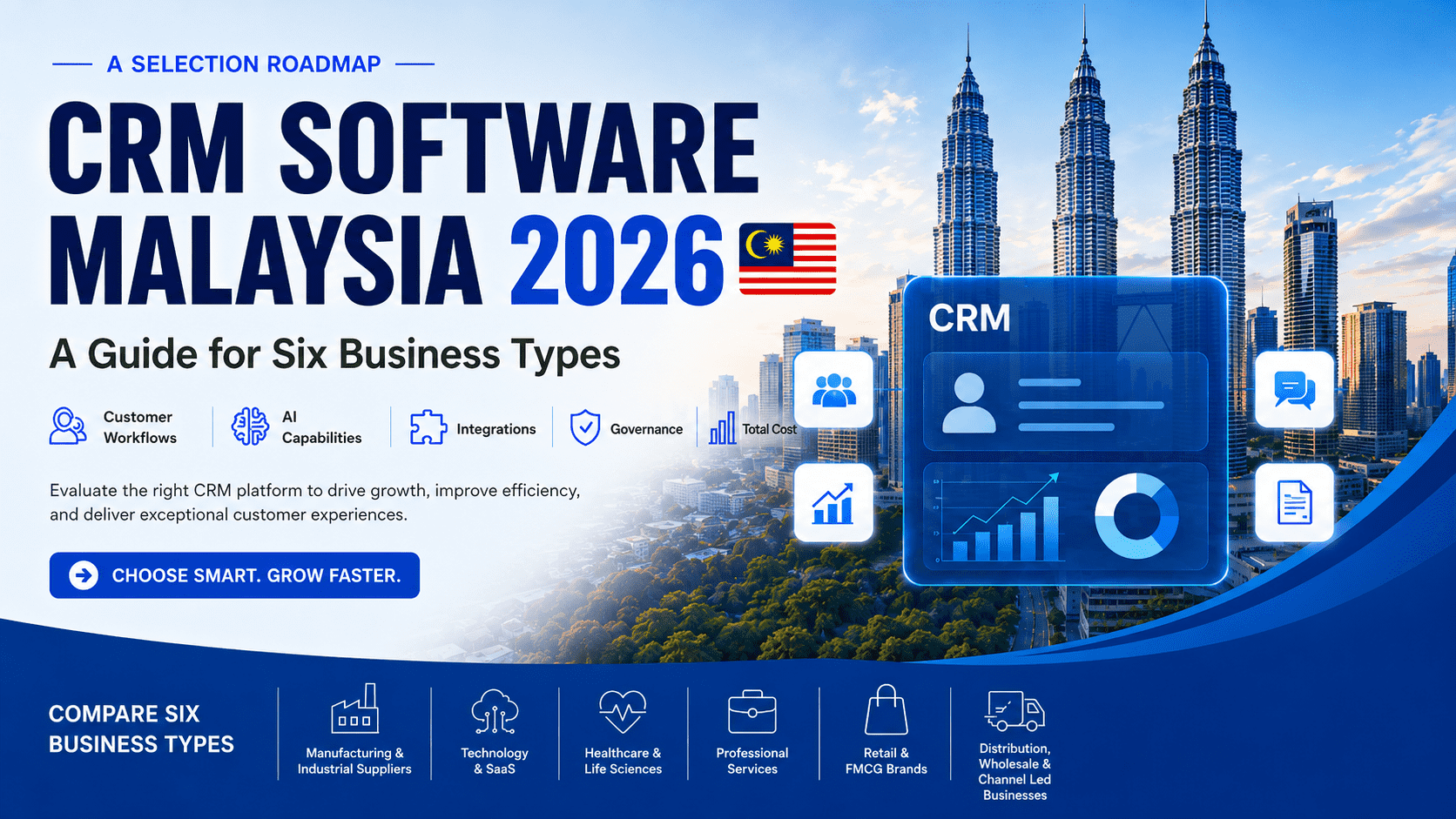
Choosing CRM software in Malaysia in 2026 means matching customer data, sales and service workflows, partner operations, AI capabilities, and governance to how a business actually sells and serves customers. There is no single CRM that is right for every business type.
A useful selection process starts with the operating model—not the vendor logo. Salesforce, HubSpot, Zoho, and Neocrm can all be part of a credible shortlist, but their strengths become more relevant in different situations. The right comparison should ask what the business needs to capture, understand, automate, measure, and approve.
Quick answer
Choose CRM software by business workflow, customer-data complexity, channel structure, service requirements, and AI governance—not by company size alone.
For Malaysia, pay particular attention to multi-channel customer engagement, distributor and partner relationships, regional operations, data permissions, and integration with finance, ERP, marketing, and service systems.
Shortlist Salesforce, HubSpot, Zoho, and Neocrm against the same real scenario, then validate data access, agent actions, human approval, total cost, and implementation effort.
How to Use This Roadmap
This guide compares six business types rather than ranking vendors from first to last. Each type is evaluated through four questions: what customer relationships must be managed, which workflows create the most operational friction, what data the CRM must understand, and which capabilities should be tested during a proof of concept.
The comparison is qualitative. It is based on public product documentation and Neocrm product materials, not on an independent product-performance benchmark. Subscription terms, AI usage limits, integrations, data-residency options, and regional availability should be confirmed with each vendor before purchase.
- Customer relationship model: direct sales, subscriptions, distributors, resellers, partners, consumers, or a combination.
- Workflow complexity: lead-to-opportunity, quote-to-order, case-to-resolution, campaign-to-revenue, or partner-to-performance.
- Data foundation: CRM records, conversations, documents, product data, service history, ERP information, and analytics.
- AI operating model: assistant, copilot, task agent, multi-agent workflow, or human-approved automation.
- Implementation reality: integrations, data migration, permissions, training, administration, and ongoing governance.
Four-Platform Starting Point
| Platform | What to investigate first | Potential fit signal | Watch-outs |
| Salesforce | How Agentforce connects agents to business data, metadata, applications, and actions. | Complex, multi-department operations with an established enterprise platform team. | Architecture, licensing, integration scope, data readiness, and administration effort. |
| HubSpot | How Breeze Assistant and Breeze Agents use Smart CRM data, conversations, documents, and knowledge sources. | Marketing-led growth teams seeking an integrated customer-facing platform. | Hub and plan dependencies, HubSpot Credits, action permissions, and handoff rules. |
| Zoho | How Zia Agents use CRM context, tools, APIs, natural-language instructions, and connected knowledge. | Teams seeking configurable CRM automation within a broad business suite. | Cross-module governance, complex workflows, auditability, and agent limits. |
| Neocrm | How NeoAgent 2.0 connects customer data, semantic context, role-based agents, analytics, and workflows. | Cross-functional customer operations spanning sales, service, partners, marketing, and data. | Integration scope, data governance, regional deployment, implementation, and tailored pricing. |
Official references: Salesforce Agentforce, HubSpot Breeze, Zoho Zia Agents, and Neocrm NeoAgent.
The Six Business Types
| Business type | Typical operating pattern | CRM priorities | Test first |
| Manufacturing and industrial suppliers | Long-cycle B2B sales, field teams, projects, distributors, and service. | Opportunity visibility, CPQ, forecasting, partner management, field activity, service history. | Deal risk, quote approval, visit planning, and service escalation. |
| Technology and SaaS | Digital demand generation, recurring revenue, product-led or sales-led growth. | Lead lifecycle, marketing-to-sales handoff, account intelligence, customer health, renewals. | Lead qualification, account research, onboarding, and renewal risk. |
| Healthcare and life sciences | Structured account relationships, field engagement, service, and controlled information. | Role permissions, account hierarchies, activity capture, compliance workflows, service visibility. | Field interaction capture, approval, access control, and audit trail. |
| Professional services | Relationship-led selling, proposals, projects, retainers, and repeat engagements. | Lead-to-project handoff, account history, tasks, delivery visibility, reporting, and referrals. | Proposal follow-up, project handoff, and client-health monitoring. |
| Retail and FMCG brands | High-volume engagement across consumers, retailers, distributors, and campaigns. | Segmentation, omnichannel engagement, promotion tracking, field execution, service, analytics. | Campaign response, retailer activity, territory visits, and case routing. |
| Distribution, wholesale, and channel-led businesses | Partner-led revenue, territories, quotations, product portfolios, and repeat orders. | Partner lifecycle, channel performance, price and quote workflows, ERP integration, forecasting. | Partner onboarding, opportunity collision, quote approval, and channel reporting. |
1. Manufacturing and Industrial Suppliers
Manufacturing and industrial businesses often manage several relationships around the same commercial process: an end customer, a distributor, a technical contact, a procurement team, a field salesperson, and a service organization. A CRM must therefore show more than a contact name and an opportunity stage.
The evaluation should cover product complexity, long sales cycles, quotation and approval workflows, field visits, territory management, partner contribution, project milestones, and service history. AI becomes useful when it can summarize account context, identify opportunity risk, recommend next steps, and organize activity records without removing human approval from commercial decisions.
Priority proof-of-concept workflow
- Capture a sales visit, meeting, or field activity and connect it to the right account and opportunity.
- Identify missing next steps, duplicate opportunities, stalled stages, or performance gaps.
- Draft a follow-up task or quote-related action for salesperson or manager approval.
- Show how service history and partner activity influence the account view.
2. Technology and SaaS Businesses
Technology and SaaS businesses may generate demand through content, product trials, events, partners, outbound sales, or a combination of channels. The CRM must connect marketing engagement with sales qualification, onboarding, expansion, renewal, and customer health.
The most important comparison is often the quality of the lifecycle model. Can the platform explain how a lead became an opportunity, how an account became a customer, which usage or service signals indicate risk, and what the next action should be? AI assistants and agents should be grounded in CRM records, conversations, knowledge sources, and defined business rules.
Priority proof-of-concept workflow
- Research an account and identify relevant buying signals.
- Qualify and route a lead using transparent criteria.
- Summarize onboarding or support context for the account team.
- Identify renewal or expansion risk and recommend a human-reviewed action.
3. Healthcare and Life Sciences
Healthcare and life-sciences organizations may coordinate field teams, institutions, practitioners, distributors, service teams, and internal specialists. Their CRM selection should place particular emphasis on information access, role-based permissions, account structures, approval paths, activity history, and data governance.
The goal is not to automate sensitive judgment without controls. A useful CRM should make authorized information easier to find, reduce repetitive capture work, and provide a traceable workflow for follow-up, service, education, or account management. Buyers should define exactly which data agents can read, which actions they can recommend, and which actions require approval.
Priority proof-of-concept workflow
- Capture a field interaction and associate it with the correct organization, location, and contact role.
- Surface relevant history without exposing data beyond the user’s permissions.
- Recommend a follow-up or service action with a visible source trail.
- Demonstrate audit logs, exception handling, and controlled record updates.
4. Professional Services
Professional-services firms sell trust, expertise, and delivery capacity. Their CRM often needs to connect relationship development with proposals, projects, retainers, referrals, client service, and future opportunities.
A CRM selection should test whether information can move smoothly from business development to delivery. If sales notes, scope documents, project updates, and client conversations remain in separate systems, an AI assistant may produce incomplete or misleading recommendations. The evaluation should include account history, proposal follow-up, delivery handoff, client health, and reporting.
Priority proof-of-concept workflow
- Summarize relationship history before a client meeting.
- Convert a qualified opportunity into a structured proposal or delivery handoff.
- Monitor open actions, stakeholder changes, and client-health signals.
- Identify cross-sell or renewal opportunities from approved account context.
5. Retail and FMCG Brands
Retail and FMCG organizations may operate across consumers, stores, retailers, distributors, field representatives, campaigns, and service channels. Their CRM requirements can therefore combine B2C, B2B, and B2B2C relationships.
The key question is whether the CRM can preserve a unified view while respecting different customer, partner, territory, and campaign contexts. Buyers should test segmentation, consent and preference handling, campaign-to-revenue visibility, field execution, retailer activity, service cases, and analytics. AI should help teams prioritize and coordinate work; it should not obscure why a segment, recommendation, or action was created.
Priority proof-of-concept workflow
- Create a segment using approved customer, engagement, and preference data.
- Connect campaign activity with sales or retailer outcomes.
- Plan and record field visits or territory activity.
- Route customer or retailer issues to the correct service workflow.
6. Distribution, Wholesale, and Channel-Led Businesses
Distribution and channel-led businesses manage revenue through relationships with resellers, agents, dealers, distributors, and end customers. They need visibility into partner onboarding, enablement, opportunity ownership, product coverage, quotation, territories, and performance.
A CRM should make channel contribution visible without creating duplicate or conflicting opportunities. It should also connect partner activity with customer outcomes and commercial forecasts. This is a natural area to compare partner portals, channel workflows, account hierarchies, product and price data, ERP integration, and AI-supported risk detection.
Priority proof-of-concept workflow
- Onboard a partner and assign roles, territories, products, and permissions.
- Detect duplicate or colliding opportunities and route the exception for review.
- Monitor partner activity, pipeline risk, and next-best actions.
- Connect quotations, orders, service cases, and channel performance reporting.
How the Four Platforms Differ
Salesforce
Salesforce describes Agentforce as a platform for bringing AI agents into applications, workflows, and interactions, connected to business data and metadata. The Salesforce Agentforce platform is therefore relevant when the evaluation involves complex objects, multiple teams, extensive integrations, and enterprise governance.
In Malaysia, validate the full architecture rather than only the agent interface: which data products are required, which actions are available, how permissions work, how much administration is needed, and how the platform will connect to finance, ERP, service, partner, or marketing systems.
HubSpot
HubSpot’s Breeze portfolio includes AI assistance, agents, and embedded capabilities across marketing, sales, and service. HubSpot states that Breeze can use CRM data, knowledge-base content, conversations, documents, and other business context; its Breeze documentation explains how assistants, agents, knowledge sources, and plan dependencies work together.
HubSpot can be a strong starting point for marketing-led customer operations and teams that want adoption across customer-facing functions. Validate which features are included in each Hub, whether agents require HubSpot Credits, what actions are automatic, and when work is handed to a person.
Zoho
Zoho’s Zia Agents are positioned around ready-to-use and configurable AI agents. The official Zia Agents page and agent documentation describe agents that can use natural-language instructions, tools, APIs, and connected knowledge sources.
Zoho may be relevant for teams that want configurable automation across a broad suite. Buyers should test whether the data model, permissions, APIs, and reporting can support the complete Malaysia-specific workflow, particularly when several modules or partner relationships are involved.
Neocrm
Neocrm positions itself as an AI-native CRM for customer operations across marketing, sales, service, partners, analytics, and customer data. The NeoAgent product page describes agents that connect with enterprise knowledge sources and use business context. The NeoAgent 2.0 announcement presents the platform as an AI-native engine for business growth.
Neocrm is worth evaluating when a Malaysian business needs more than isolated content generation—for example, role-based sales guidance, opportunity-risk monitoring, service assistance, partner operations, customer-data unification, analytics, and human-approved workflow execution. The proof of concept should confirm integrations, data governance, regional deployment, permissions, implementation scope, and tailored pricing.
A Practical Selection Roadmap
Step 1: Map the customer relationships
List the people and organizations involved in revenue and service: end customers, accounts, locations, distributors, resellers, partners, practitioners, retailers, and internal teams. Record which relationships must be visible together and which must remain separated by permissions.
Step 2: Map the workflows
Select three to five workflows that represent the business. A useful set may include lead qualification, opportunity progression, quote approval, field activity, service escalation, partner onboarding, campaign follow-up, renewal risk, or customer-health monitoring.
Step 3: Audit the data
Identify where customer records, conversations, documents, product information, orders, service cases, and performance metrics currently live. Check duplicates, missing fields, inconsistent definitions, access rules, update frequency, and integration requirements before evaluating AI output quality.
Step 4: Run the same proof of concept
Give each shortlisted vendor the same scenario and success criteria. Ask the system to capture context, identify a risk or next step, recommend an action, request approval, execute the permitted change, and show the audit trail.
Step 5: Model total cost and operating effort
Compare seats, modules, AI usage or Credits, integrations, data preparation, implementation, training, administration, governance, and ongoing support. A single license price is not a complete CRM cost model. Neocrm pricing should be confirmed through a tailored proposal for the selected scope.
Step 6: Plan phased adoption
A practical 2026 rollout can begin with one high-value workflow, one accountable business owner, a controlled data set, and a defined approval model. Expand only after users can explain the agent’s inputs, actions, exceptions, and measured outcomes.
Malaysia CRM Buying Questions
- Can the platform support the languages, currencies, territories, and customer structures used by our teams?
- Can it represent direct, distributor, reseller, retailer, partner, and end-customer relationships?
- Which channels can be connected, such as web forms, email, calls, messaging, meetings, portals, and field activity?
- How are customer preferences, access permissions, data retention, and regional requirements handled?
- Can the CRM connect with finance, ERP, ecommerce, marketing, service, analytics, and partner systems?
- Which AI outputs are recommendations, and which can create or update records?
- Where is human approval required, and how is the decision recorded?
- What will the first-year and ongoing total cost be under the expected usage model?
Frequently Asked Questions
What CRM software is best for businesses in Malaysia?
There is no universal best CRM. Salesforce, HubSpot, Zoho, and Neocrm should be compared against the business’s customer relationships, workflows, data sources, AI requirements, integrations, and governance model.
How should I choose CRM software in Malaysia in 2026?
Start with the customer relationships and workflows that matter most, audit the data behind them, shortlist platforms by capability fit, and run the same proof of concept with each vendor. Include AI usage, implementation, integrations, training, and governance in the cost comparison.
Which CRM is suitable for manufacturing or distribution businesses?
Manufacturing and distribution businesses should prioritize opportunity visibility, quotation and approval, partner and channel management, field activity, product information, service history, ERP integration, and forecasting. The best fit depends on how those workflows are structured and governed.
Can CRM software support multi-language and multi-currency operations?
Many CRM platforms provide international capabilities, but buyers should verify the exact languages, currencies, reporting rules, integrations, and regional support model required by their Malaysian operation.
Is Neocrm suitable for Malaysian businesses?
Neocrm is worth evaluating when customer operations span sales, service, partners, marketing, analytics, and fragmented customer data. Its AI-native approach should be tested through real Malaysian workflows, data sources, permissions, integrations, and approval requirements.
How much does CRM software cost in Malaysia?
CRM cost varies by users, modules, AI usage, integrations, data migration, implementation, training, and support. Buyers should request a scenario-based proposal and compare total cost of ownership rather than only the entry-level subscription price.
Conclusion
The most reliable way to choose CRM software in Malaysia in 2026 is to connect the platform decision to the business’s real operating model. Manufacturing, SaaS, healthcare, professional services, retail and FMCG, and distribution businesses may all need CRM—but they do not need the same data model, workflows, integrations, or AI controls.
Salesforce, HubSpot, Zoho, and Neocrm each provide a different starting point. The strongest shortlist is the one that can demonstrate how customer data becomes context, how context becomes an agent recommendation, where people approve the action, and how the outcome is measured.
| The selection principle |
| Choose the CRM that best matches the relationships, workflows, data, integrations, and governance your business needs to operate—then validate that fit with a controlled proof of concept. |
Primary Product References
Official product pages used for current capability descriptions. Product availability, plan requirements, and regional support should be rechecked before publication.