What is an AI-native CRM? At its core, it is an enterprise platform built with specialized AI agents at the center. These agents orchestrate and coordinate complex CRM workflows on behalf of the user, often eliminating the need to ever navigate a traditional software interface.
While general-purpose AI tools have captured global attention, major industry analysts point out that enterprise value lies in domain-specific execution. According to Gartner, by 2028, at least 50% of enterprise software applications will incorporate specialized AI agents designed to execute end-to-end task orchestration within specific business domains—moving beyond simple prompt-response interactions toward deep systems integration. Analysts emphasize that while AI agents will eventually outnumber human sellers, simply having more agents will not automatically translate to productivity unless they are built on domain expertise, unified data foundations, and structured workflows.
Here is why domain specialization matters, how AI-native agents transform daily sales operations, and why the underlying CRM backend remains irreplaceable.
1. A Day in the Life: How AI Agents Transform Sales Operations
Managing 30+ accounts simultaneously makes it difficult for any salesperson to recall every past interaction, track ongoing service issues, or pull financial context trapped across disparate software modules. Traditionally, gathering this intelligence required manually digging through multiple screens and databases.
AI-native CRM agents streamline this entire operational loop into minutes:
- Pre-Meeting Prep: The agent aggregates account history, open support tickets, opportunity status, and recent public news to deliver a concise briefing with recommended talking points right before a meeting.
- Zero-Screen Updates: Instead of filling out tedious CRM screens, the salesperson simply dictates a voice summary after a client call. The agent parses the conversation, updates the relevant CRM fields, and records the activity.
- Executive Inspection & Independent Assessment: At the end of the week, when a sales director wants to know the outcome of an important opportunity, they can inspect the update directly and ask the AI for a summary alongside an independent deal assessment. Based on this analysis, the director provides guidance and instructs the agent to create a targeted to-do item for the rep (e.g., ‘Contact a partner who may have a relationship in this account’). The rep receives an instant notification with a set deadline.
- Pipeline Health & Forecasting: The sales director can also quickly ask the AI for a real-time health check on the current pipeline, an automated assessment of whether the team can hit its quarterly target, and recommended actions to close forecasted gaps.
Doing this manually used to take hours per week. Multiplied across an entire sales organization over a year, this workflow shift recovers thousands of hours of lost productivity.
2. Generic AI Agents vs. Specialized CRM Agents
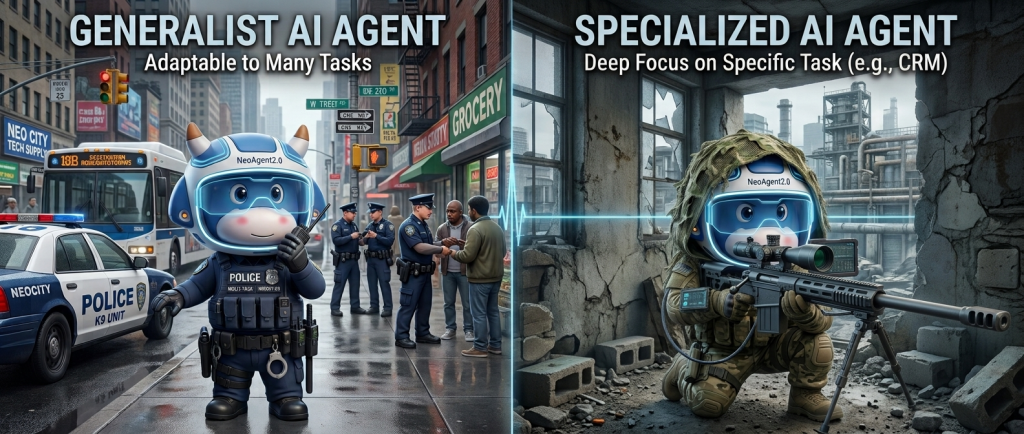
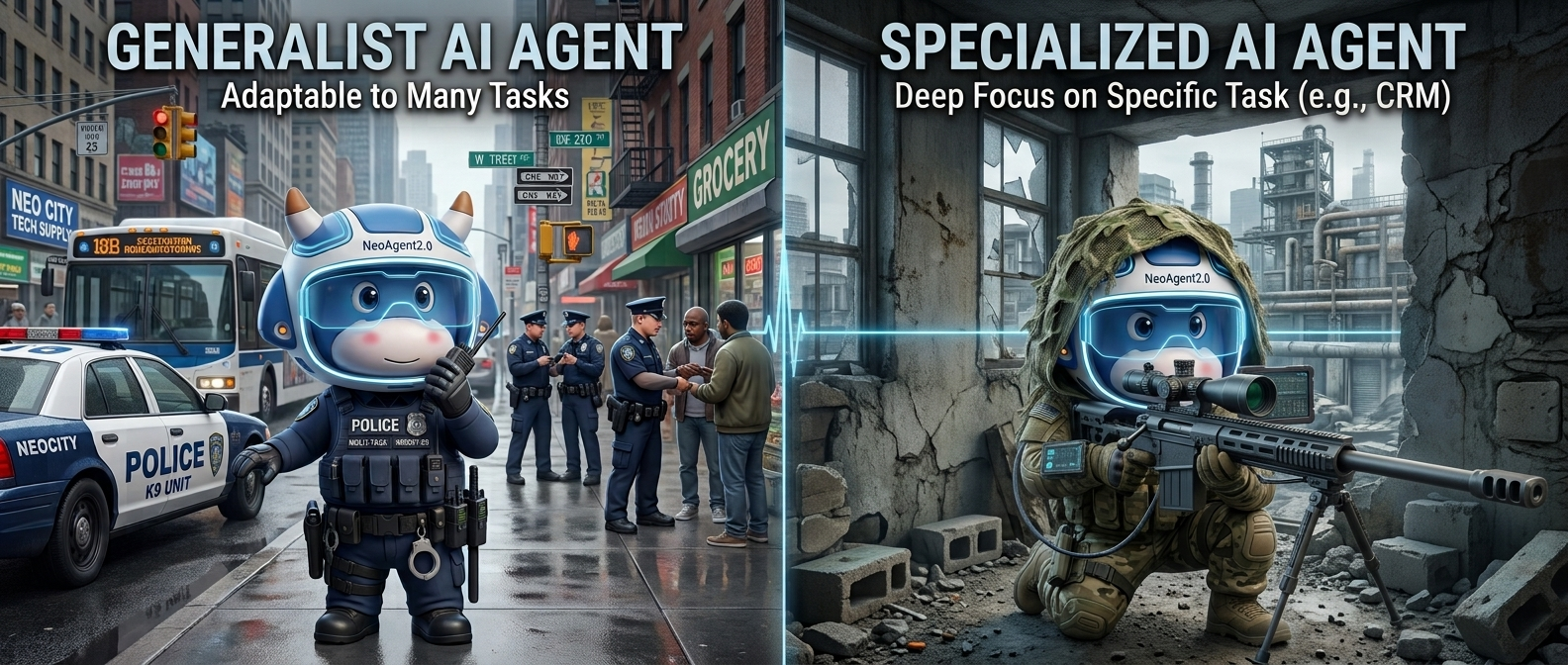
Many organizations wonder why they cannot simply deploy a generic LLM agent to handle specialized tasks. The distinction is clear in the comparison above: a police officer handles a wide variety of general security duties, but a sniper is brought in when a specific task requires precise execution (pun intended). In terms of enterprise software, this is akin to using a simple Form Builder application vs an Enterprise Resource Planning (ERP) system.
| Generic AI Agents | CRM-Specialized AI Agents |
| Focus: Task Orchestration & Drafting • Handles basic scheduling and email drafts • Operates on general prompt reasoning • Lacks embedded business logic | Focus: Domain Execution & Intelligence • Recommends deal next steps & cross-sell targets • Accesses real-time pipeline, discount & account history • Suggests strategies to meet quarterly targets |
| Data Access & Governance • Lacks native access to customer database • Missing field-level security roles • No built-in compliance audit trails | Data Access & Governance • Fully integrated with enterprise CRM data schemas • Enforces strict access control & security policies • Maintains complete auditability across interactions |
A generic agent can send a calendar invite or draft a standard follow-up email. However, it cannot evaluate deal health or tell a sales rep which product cross-sell offer has the highest win probability for a specific account tier. A specialized CRM agent can perform this analysis because it understands your historical conversion metrics, pricing guardrails, and account structures.
Other CRM Specialized Scenario Examples
- Lead Qualification & Prioritization: Ranking incoming leads based on available data and historical conversion footprints rather than arbitrary scoring rules.
- Assisted Quote & Order Creation: Recommending deal structures while referencing historical discount data, contract terms, and customer tiering to eliminate manual entry errors.
- Pricing Intelligence: Suggesting optimized price points based on regional market conditions, industry verticals, and deal size—bringing executive-level pricing strategy directly to the field rep.
- Automated Service Routing: Parsing unstructured inbound emails or chats to automatically create tickets, suggest knowledge base resolutions, and reduce onboarding time for new support staff.
3. If AI Agents Do the Work, Why Do You Still Need a CRM?
If an AI agent can read, write, and execute workflows, is the traditional CRM system obsolete? No. A modern CRM is not just a UI; it is a repository of business logic, security protocols, and operational best practices built over decades.
| “You can ask AI to build something based on your CRM requirements, but if your requirements lack depth or have no subject matter expert input, then what you are building is no better than a form with a database behind. I still require heavy time investment from business users, which takes them away from their core job.” — Enterprise IT Leader |
An AI-native CRM provides the best of both worlds:
1. Structured Governance: It maintains critical backend requirements—role-based access control, field-level security, data validation, and regulatory audit trails.
2. AI-Aware Architecture: The underlying CRM is built to expose data schemas, workflows, and contextual boundaries directly to AI reasoning engines without data corruption or security leaks. This is the fundamental difference between regular CRM and Native-AI CRM.
3. Fluid User Interaction: Humans interact through flexible conversational interfaces while the backend ensures every transaction lands in a structured enterprise database.
4. What Does the Future Hold for CRM-Specialized Agents?
Looking ahead, the shift toward domain-specialized architecture will fundamentally alter how software is acquired, adopted, and orchestrated across the enterprise:
- Subscribing to Agents, Not Just Software Seats: Future software adoption will no longer be determined by traditional user license seats, but by the effectiveness and operational capability of the CRM agent itself.
- CRM Becoming Truly Ubiquitous: CRM functionality will break out of its traditional silo. Any AI agent across the business can tap into CRM capabilities simply by subscribing to a Native-AI CRM or CRM Agent, automatically inheriting all the best-practice processes, governance, and data models that come with it.
- Becoming THE Institutional Sales Coach: When senior sellers leave an organization, valuable deal experience is often lost. A specialized agent that understands all the subtle nuances of how each deal was won or lost turns that implicit knowledge into a permanent competitive moat. Over time, the agent transforms into the ultimate sales coach (though fulfilling this vision requires key data and operational preconditions to be in place).
- Multi-Agent Collaboration Across the Enterprise: As AI adoption scales, multiple specialized agents will operate across different functions and collaborate seamlessly. For example, when a sales or service team encounters complex legal queries during deal execution, the CRM agent can hand off the task to a specialized Legal AI Agent for contract review—all while preserving auditability across the process to comply with internal policy and regulatory requirements.
| The Bottom Line Top-performing sales reps succeed because they plan thoroughly, leverage deep account insights, and maintain structured follow-ups. Specialized CRM agents democratize those habits across the entire team—elevating average performers into top-tier producers while keeping enterprise data secure and structured. |