As AI moves from technical concepts into real world use-cases, a fundamental question emerges: Who can truly leverage AI to deliver enterprise growth?
Over the past year, the adoption of AI has accelerated far beyond expectations. On the consumer side, globally there are more than 1 billion monthly active users of Generative AI, or 18% of the working age population (averaging 30+% in mature markets). On the enterprise side, between 78-88% of global enterprises report active AI deployment across business functions. Agents are rapidly taking over business execution—IDC predicts that the number of active global Agents will grow from 28.6 million in 2025 to 2.2 billion by 2030, while Gartner notes that Fortune 500 companies will manage an average of 150,000 Agents by 2028.
AI is no longer an optional question; it is a matter of survival.
At the same time, the US-China AI race has formed a duopoly. Stanford University’s AI Index Report 2025 concludes that the US leads in foundational research, such as chips and large language models, while China holds a distinct advantage in AI application deployment. All this against the background that global AI spending is expected to top $300B in 2026, according to IDC research.
In this global race, Andy Deng, CEO of Neocrm—presented a core insight at the Engage 2026 conference: The competition in AI is no longer a race of technical parameters, but a contest of who can truly embed AI into the enterprise growth process. And CRM is the very first stop on this pathway.
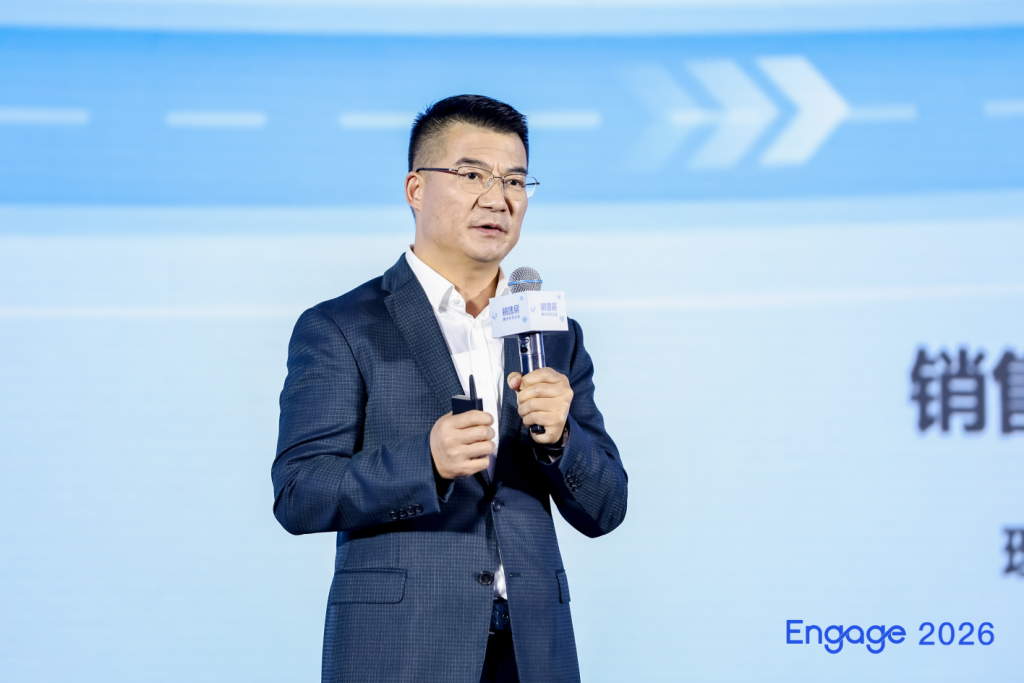
Andy Deng, CEO of Neocrm
1. CRM Is the Best Choice for Enterprises Seeking Growth via AI
Following the widespread adoption of AI, the next question facing enterprises is: As we demand growth from AI, where is the primary pathway?
The answer is CRM.
CRM is the only system that spans the entire customer lifecycle—from acquisition, conversion, and service to retention. Being closest to revenue, it serves as the optimal landing spot for growth conversion. Fortune Business Insight data shows that the global CRM market in 2025 reached a staggering 113B USD. Concurrently, more than 80% of enterprises have listed AI capabilities as a mandatory metric in their CRM procurement and selection.
However, today’s CRM market coexists in “three generations”:
- Traditional CRM is a system of record. Sales representatives fill out forms, and managers view reports; its essence is recording “what happened.”
- AI CRM 1.0 overlays AI features onto traditional CRM—adding a dialogue box for Q&A where the AI offers recommendations based on retrieval, but the core processes remain unchanged.
- AI CRM 2.0 is AI-native CRM—able to understand business context, execute work autonomously, and deliver actual results, requiring humans only to set goals and boundaries.
The gap among these three represents a generational leap. This gap is analogous to a horse-drawn carriage: no matter how fine the horses or how elaborate the saddles, it will never transform into an automobile.
2. True AI-Native CRM Must Overcome 4 Challenges
What the industry needs is not an “old system bolted on with AI features,” but a true new environment built for AI. Neocrm believes that a true AI-native CRM must cross four distinct thresholds or challenges:
- The First Challenge: Data — Moving from “Record” to “Memory.” Traditional CRM records what happened; AI-native CRM needs to retain why it happened and what should be done next. The value of data hinges on whether it can be reasoned through and securely referenced.
- The Second Challenge: Agent — Moving from “Tool” to “Labor.” An Agent is not just a feature in a drop-down menu; it is a genuine role. Interaction shifts from “filling out forms” to “assigning objectives.” Performance metrics shift from “seats purchased” to “work completed,” and pricing evolves from seat-based licenses toward outcome-based models.
- The Third Challenge: Process — Moving from “Human-Supervised Systems” to “Self-Running Systems.” In the past, humans filled out tickets, ran approval chains, and waited for status updates, pushing everything forward manually. Now, humans only set the goals and boundaries—the system breaks down tasks, allocates resources, dynamically adjusts, and even self-corrects when encountering issues.
- The Fourth Challenge: Trust — Consistency and Reliability. Permission inheritance, auditability, interpretability, and the ability to hand tasks back to humans when the model encounters uncertainty—these must be built into the core engine rather than applied as post-hoc patches. Capability determines what AI can do; trust determines what it is permitted to do.
Neocrm has successfully overcome these challenges to create an AI-native CRM—NeoAgent 2.0.
3. As AI Floods the Market, Neocrm Pursues Real-World Impact
In February this year, Anthropic released Claude Cowork, causing “SaaS Doomsday” narratives to swirl. Six months later, Salesforce stock surged nearly 23% in a single day, when Anthropic + Salesforce announced Claudeforce. Model creators and SaaS giants began joining forces to embed AI deep within enterprise operations.
The market also presents a starkly polarized landscape: Over 2,500 SaaS companies worldwide have closed or shut down since 2022. But simultaneously, more than $100B is being invested globally in AI applications, with 83% of all SaaS venture capital flowing to AI startups.
SaaS is not facing an apocalypse; it is undergoing a complete reconstruction—evolving from Software as a Service to Agent as a Service, with Agents becoming the new format for software delivery. Only enterprises that successfully pivot and deploy specialized native-AI agents, can help customers navigate these changes.
Why is Neocrm able to make this change?
- 15 Years of Deep Industry Domain Expertise: Serving 6,000+ large and medium-sized enterprises, Neocrm has codified complex business logic across 60+ industry sub-verticals, including manufacturing, healthcare, and high-tech. This industry know-how is the core asset enabling AI to comprehend business semantics. Today’s market does not lack AI technology vendors; it lacks companies that understand both AI and deep industry domain operations.
- Strategic Integration to China and Global AI Frameworks: In China, Neocrm is fully integrated into Tencent’s product ecosystem – providing an end-to-end solution for all enterprises, while leveraging Tencent TokenHub to integrate to various local AI models (including Tencent Hunyuan). Globally, Neocrm similarly uses AWS AI Foundation framework to integrate with Claude LLM for its AI capabilities. This dual framework enables Neocrm to give the ultimate choice to the customer – deploy the best option for their environment
Moving forward, Neocrm continues to partner with Tencent and AWS, build broader ecosystems, co-innovate and create joint prosperity.
The year 2026 marks the eve of the AI CRM explosion, a period of market reshaping and realignment. Neocrm’s mission is clear: to stay rooted in industry expertise, leverage the ecosystem, and deliver tangible, measurable value through every real-world business scenario. This is where AI CRM becomes reality.