TABLE OF CONTENTS
1. The Missing Link in Your Modern Marketing Stack
2. The Business Case: How This Value Model Pays for Itself
4. Expanding the Blueprint: Bridging B2B2C into the CDP Conversation
5. Buyer’s Guide: What Marketers Should Look For in a Vendor
6. Looking Forward: How AI Can Accelerate CDP + MA into an Autonomous Growth Engine
Executive Summary
For years, businesses have relied on Customer Relationship Management (CRM) systems to act as the digital address book for their customer relationships. They track who bought what, when they bought it, and how much they spent. But in today’s fast-paced digital world, a traditional CRM is no longer enough.
Modern consumers don’t just buy; they interact. They browse your website, abandon items in shopping carts on your app, click on social media ads, and interact with your messaging accounts long before a transaction ever happens. Because traditional CRMs aren’t built to capture this fast-moving digital footprint, marketing teams are often left running blind—sending generic, repetitive blast messages that alienate customers and waste valuable ad budgets.
The solution lies in combining two powerful engines: a Customer Data Platform (CDP) and a Marketing Automation (MA) system. This whitepaper explains how bridging the gap between customer data and marketing execution unlocks explosive revenue growth, slashes advertising waste, and delivers the highly personalized experiences modern consumers expect.
1. The Missing Link in Your Modern Marketing Stack
The Problem: Your Data is Broken Into Silos
Every day, your customers leave a trail of clues about what they want. They might spend ten minutes looking at a specific product on your mobile app, click a marketing promo on WhatsApp, or walk into a physical store to look at a display.
The issue is that this information is typically trapped in completely different systems. Your email tool doesn’t talk to your website tracker; your retail point-of-sale system doesn’t sync with your social media advertising account. This fragmentation creates three major headaches for marketing teams:
- The “Blind Spot” Profile: You see a customer as five different people because their email, phone number, website cookies, and loyalty card aren’t tied together.
- Bad Timing: Because data is processed in slow nightly batches, you miss the golden window to send an offer when a customer is actively browsing a product.
- Marketing Fatigue: When systems don’t talk to each other, you accidentally send the same customer an email, an SMS, and a WhatsApp message all on the same day, causing them to hit the “unsubscribe” button out of sheer frustration.
The Solution: The “Brain” and the “Muscle”
To fix this, smart enterprises layer a CDP and an MA system directly onto their existing CRM ecosystem. Think of it as upgrading your marketing department with a brain and a muscle.
- The CDP is the Brain: It acts as a universal sponge, instantly absorbing customer interactions from your website, apps, offline stores, and ads. It cleans this data and pieces it together into a single, comprehensive profile for every single individual. It then labels customers with smart tags (e.g., “High-Value Shoe Lover” or “At Risk of Churning”).
- Marketing Automation is the Muscle: It takes the unified insight from the brain and instantly acts on it. It ensures that when a customer triggers a specific behavior, they automatically receive the perfect message on the channel they prefer – whether it’s a WhatsApp message, a push notification, an SMS, or a tailored social media ad.
2. The Business Case: How This Value Model Pays for Itself
Many brands assume that investing in enterprise customer data tools is just a luxury software expense. However, global research demonstrates that centralizing your data scales your profits dynamically.
No matter where your annual revenue falls on the spectrum – from a fast-growing USD 5 Million brand to a major USD 500+ Million enterprise – unifying your data drives a highly predictable financial return. The business case is built on three simple pillars validated by global research firms such as McKinsey, Forrester, and Gartner.
Pillar 1: Boosting Revenue with Relevant Messages
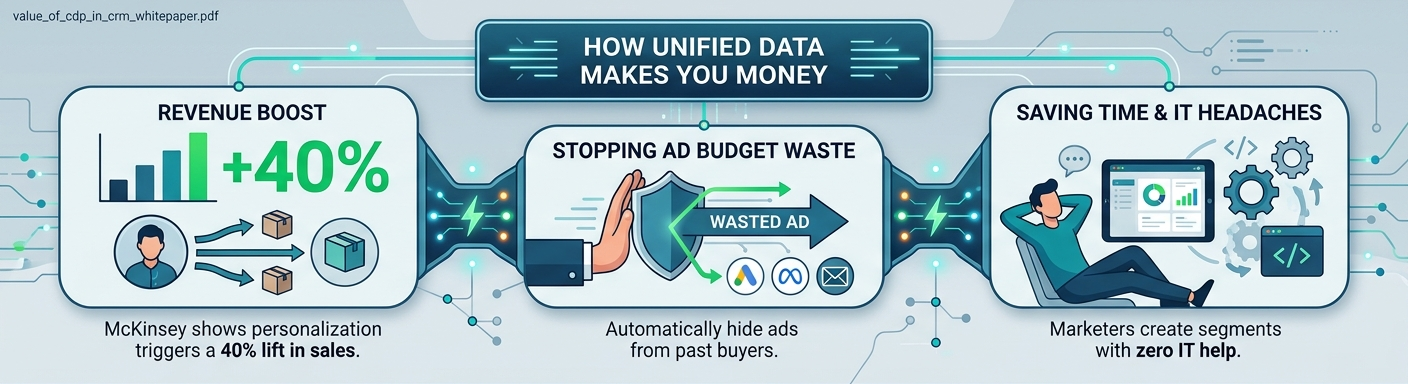
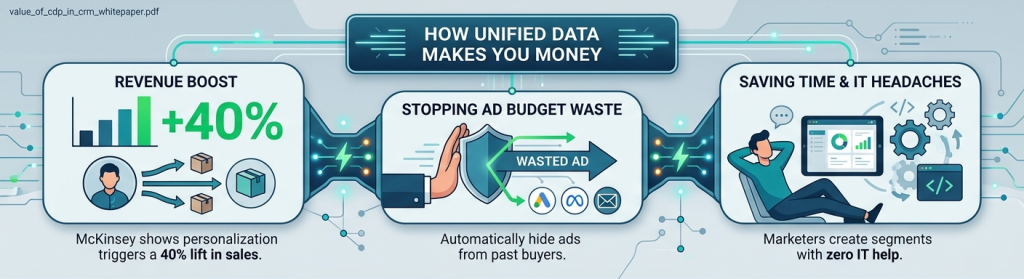
When messages are highly personalized and hit at the exact right moment, sales skyrocket.
- The Benchmark: Global consulting giant McKinsey & Company found that businesses that master personalization generate 40% more revenue from those campaigns than competitors who stick to generic blasting.
- The ROI Mechanism: Having the ability to understand your customer’s real-time interests improves your conversion rates dramatically. According to a study by Aberdeen Research, brands with an integrated CDP see a 2.9x greater year-over-year revenue growth rate because they keep their customers coming back.
Pillar 2: Stopping Advertising Budget Waste
Right now, a massive chunk of your advertising budget is slipping through the cracks because your marketing tools don’t talk to each other.
- Smart Ad Suppression: Have you ever bought a pair of shoes online, only to have ads for those exact same shoes follow you around the internet for the next two weeks? That is ad waste. An integrated CDP talks directly to your ad platforms (like Google and Meta), telling them to instantly stop showing acquisition ads to a customer the second they make a purchase. Research shows this single trick recovers 15% to 20% of wasted ad spend.
- Finding Better Lookalikes: Instead of guessing who your target audience is, you can take a list of your top 10% highest-spending, most loyal customers from your CDP and feed it into Facebook or Google to find “lookalikes.” Because your starting data is incredibly accurate, your cost to acquire new customers drops significantly.
Pillar 3: Saving Time and IT Resources
Without a central data hub, your marketing team is at the mercy of your IT department. Every time marketers want to run a holiday campaign, they have to request a data pull from IT, waiting days or potentially weeks for an Excel spreadsheet.
- Self-Serve Marketing: An integrated CDP creates an easy, visual dashboard. Marketers can build complex customer groups with a few clicks without writing a single line of code. This saves countless engineering hours and allows marketing teams to launch campaigns in minutes instead of weeks.
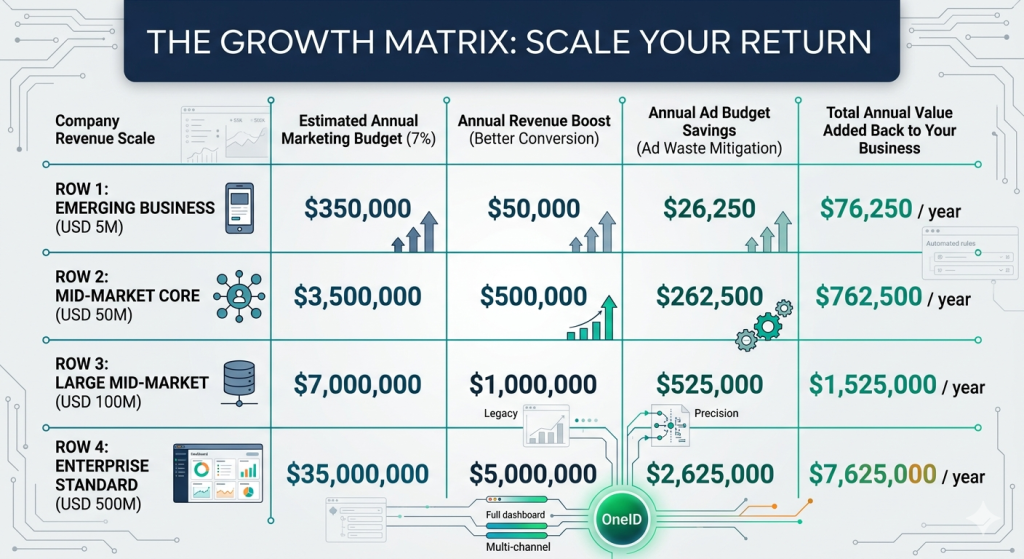
The Growth Matrix: What This Means for Your Revenue Scale
To visualize how these percentages turn into real-world profits, the matrix below details the typical annual value generated for brands across different revenue tiers, assuming a standard marketing budget allocation and a conservative operational lift.
3. Real-World Success Stories
To see how these concepts function in practice, look at how companies across major industries have used this framework to revolutionize their business metrics (below are actual customer results):
Success Story A: The Consumer Retail Brand
- The Struggle: A consumer brand with a large customer database relied on massive, undifferentiated text blasts. Because the messages weren’t personalized, their open rates dropped, ad costs climbed, and customers started opting out.
- The Solution: They connected their sales records and online channel preferences into a central platform. They broke their audience down into specific interest groups and set up automated, personalized multi-channel journeys.
- The Results:
- Sales conversion rates shot up 2.5x.
- Their total text message marketing costs dropped 4.6x because they stopped blasting people who preferred messaging apps or email.
- Average order value rose by 20% among their targeted segments.
Success Story B: The Financial Services & Insurance Provider
- The Struggle: A large financial institution managing a massive membership base suffered from fragmented data silos. Their mobile application data didn’t connect to their branch data, making it impossible to see a customer’s total relationship with the brand.
- The Solution: They implemented a centralized identity system to unify over 70 million individual customer profiles across 10 legacy internal systems, creating over 200 real-time behavioral tags for their marketing teams.
- The Results:
- Successfully captured over 2,000,000 new digital registrations via smart campaign prompts.
- Achieved an absolute 3% lift in premium conversion rates for high-value products.
- Drastically improved campaign response rates through precisely timed follow-ups.
Success Story C: The Premium Real Estate Developer
- The Struggle: A luxury property developer faced high customer acquisition costs (CAC). They spent massive sums on public banner ads, but had no tracking system to identify which leads were genuinely interested in booking property tours.
- The Solution: They added digital tracking tags to their web pages to monitor user interest (such as tracking who viewed specific residential floor plans for more than two minutes). This data triggered automated follow-up sequences inviting qualified leads to virtual walkthroughs.
- The Results:
- Lead-to-opportunity conversion rates improved to a record 10%
- The net cost to acquire a qualified lead plummeted to USD 0.40, compared to an industry average of almost USD 14.00 (cost using traditional blind advertising networks).
- Re-engaged >70,000 inactive contacts sitting dormant in their legacy database.
4. Expanding the Blueprint: Bridging B2B2C into the CDP Conversation
While the primary focus of digital engagement is often viewed through a direct-to-consumer (B2C) lens, the reality for modern enterprises is rarely that linear. Many organizations also operate a B2B2C model, where the primary business relies on a network of business partners such as regional distributors, franchised dealers, independent brokers, retail OEMs, or value-added resellers, to sell and deliver products to the end consumer.
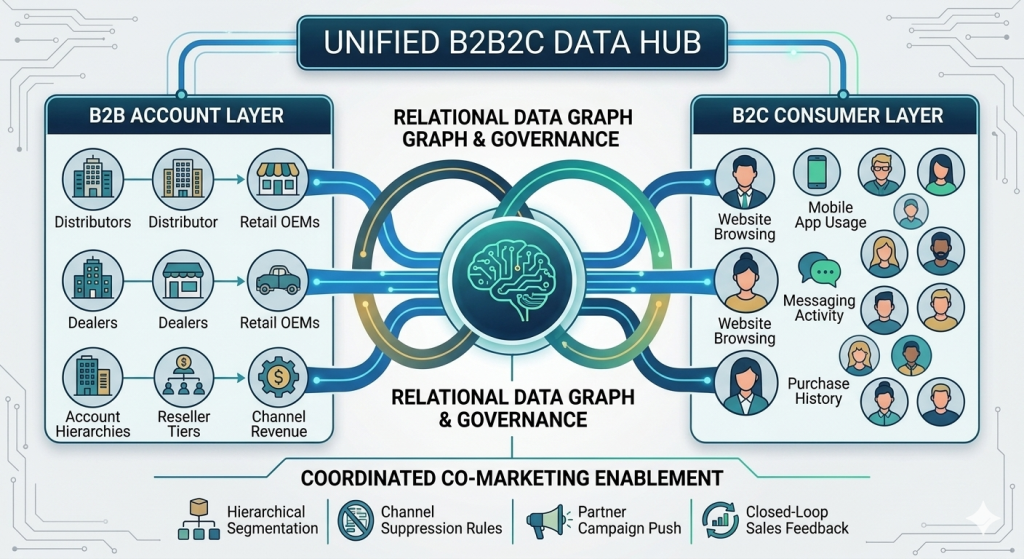
This structure traditionally creates a massive data chasm: the enterprise owns the product, the business partner owns the transactional relationship, and the digital footprint of the end consumer is entirely lost in transit. To scale effectively, a modern CDP must bridge this gap, treating both the B2B account and the end B2C user as interconnected nodes within a single data ecosystem.
The Dual-Layer Architecture: Account Profiles vs. Consumer Profiles
To bring B2B2C into the CDP conversation, the platform cannot rely on a standard B2C identity model alone. It must support a hierarchical, multi-tenant data structure that manages two distinct but overlapping profile types simultaneously:
- The B2B Account Profile: Tracks corporate entities, contract values, reseller tiers, geographic territories, and overall channel revenue and KPI
- The B2C Individual Profile: Tracks anonymous web interactions, mobile app usage, social media engagement, and behavioural intent tags of the actual end consumer.
By linking these two layers via a relational tag, the CDP maps exactly which end consumers belong to which partner entities. This allows the enterprise to understand consumer demand while respecting and empowering the partner channel.
Managing Co-Owned Users and Channel Governance
One of the biggest hurdles in a B2B2C setup is data governance: How do you manage end users who are acquired or handled by a third-party business entity? A robust CDP solves this through three core capabilities:
- Data Isolation & Access Controls: The CDP acts as a centralized brain but partitions data visibility. While the core brand has a macro-view of macro trends, individual business partners can only access and view the data of consumers explicitly mapped to their legal territory or store entity.
- Preventing “Channel Friction” via Exclusion Rules: When an end consumer is managed by a specific reseller, the enterprise must avoid direct-to-consumer marketing that undercuts the partner’s interest (e.g. marketing a coupon that could be redeemed at another partner’s store). The CDP’s segment builder allows marketers to create automated exclusion rules (e.g. “If a consumer is tagged as ‘Managed by Partner X’, automatically suppress brand-direct discount ads”), preventing channel conflict and protecting partner relationships.
- Co-Marketing Automation Empowerment: Instead of bypassing the partner, the enterprise uses the CDP + MA stack to fuel them. The central brand can build high-converting marketing journeys and push them downstream as templates to their partners. Partners can then trigger highly personalized local campaigns to their specific sub-pool of 2C consumers, leveraging the enterprise’s advanced data infrastructure without needing an IT team of their own.
Unlocking the Win-Win Value Model
Integrating B2B2C into your data strategy transforms the vendor-partner relationship from a transactional product supply chain into a shared data alliance.
By gathering anonymous top-of-funnel consumer intent (e.g., website views, configuration tool interactions) and routing those qualified leads instantly to the correct regional reseller via the CRM, the enterprise actively drives pipeline for its partners. In return, partners are incentivized to feedback point-of-sale (POS) and offline fulfillment data into the CDP, completing the loop and creating a faster, smarter, compounding intelligence flywheel across the entire B2B2C value chain.
5. Buyer’s Guide: What Marketers Should Look For in a Vendor
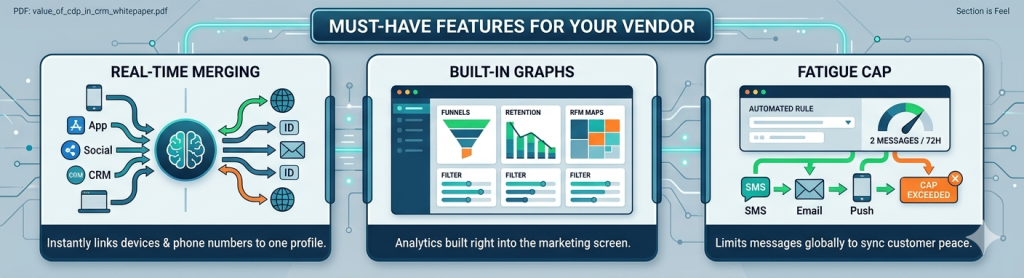
Choosing a CDP vendor can be overwhelming. Every platform promises to unify your data, but many are simply basic storage tools wrapped in a pretty interface. To ensure you choose a platform that gives your company a competitive edge, make sure your prospective vendor checks the following five boxes:
1. Instant, Real-Time Profile Merging (Deterministic Identity)
- What to watch out for: Some vendors only stitch data together once a night in a slow batch update. If a customer abandons a shopping cart at 2:00 PM, you won’t be able to trigger an automatic reminder until the next day – long after their interest has cooled.
- What you want: Look for a platform that features a real-time engine. It should instantly blend a customer’s phone number, app ID, and web cookies into one single profile the exact second they interact with your brand, updating their smart tags instantly.
2. Built-In Marketing Analytics (No Tech Degrees Required)
- What to watch out for: Many data platforms function like storage warehouses (or are data warehouses in disguise). To see a campaign report or understand customer trends, you have to export data into a secondary software tool or wait for a data analyst to run a report. Data warehouses are also only designed to present data, but don’t quickly allow the marketer to turn it into action.
- What you want: A vendor that builds advanced marketing dashboards directly into the marketer’s user interface. Your team should be able to run funnel analyses, track retention, and map loyalty distributions natively with a few simple clicks. You also want the ability to quickly take any segment grouping directly into a marketing campaign flow.
3. Global Customer Fatigue & Anti-Harassment Controls
- What to watch out for: If your marketing team runs three different campaigns at once, a customer might accidentally qualify for all three, resulting in an overwhelming barrage of text messages and emails in a single morning. Irritated customers are more likely to complain about privacy issues and one serious escalation could lead to massive productivity loss.
- What you want: Ensure the software features a built-in cross-channel capping tool. You should be able to easily check a box that says: “No matter how many campaigns a customer qualifies for, never send them more than 2 total messages within any 72-hour window.” This automatically protects your brand reputation and keeps your unsubscribe rates low.
4. Deployment Flexibility
- What to watch out for: Many global software providers only provide a public cloud server option. If your business operates in a highly regulated sector (like finance, insurance, or healthcare), your legal team might block the project because you aren’t allowed to store sensitive customer data on a third-party server.
- What you want: Look for a vendor that offers hybrid cloud agility. They should give you the choice to host the platform on a private cloud, a virtual private cloud (VPC), or as a standard cloud model, keeping your internal data compliance team fully satisfied.
5. Gold-Standard Privacy and Security Credentials
- What to watch out for: Consumer privacy regulations are tightening globally. Using a vendor with weak data security and privacy control structures puts your brand at legal and reputational risk.
- What you want: Verify that your vendor is officially audited and fully certified under top international security frameworks. They must hold official ISO 27001 (Information Security), ISO 27701 (Privacy Management), and SOC 2 Type II operational certifications to ensure your customer data remains entirely safe and secure. They must also be able to comply to local PDPA (Personal Data Protection Act) and/or EU GDPR (General Data Protection Regulation) requirements.
6. Expandability and Roadmap
- What to watch out for: If you are going to invest in a CDP solution, ensure you also plan for growth. A cheaper solution can be attractive to just get off the ground, but if your business quickly outgrows it, migrations can be costly – not because of the time and effort, but because of the opportunity loss that the solution couldn’t capitalize on.
- What you want: Look at your business strategy in the mid-long term and see if any new requirements should be catered for. For example, even in a primarily direct B2C business, B2B2C is often a quick way to provide immediate revenue uplift. Requirements may not be clear, but having a roadmap doesn’t require any additional cost. A bit of planning usually results in more savings during the lifetime of the solution.
6. Looking Forward: How AI Can Accelerate CDP + MA into an Autonomous Growth Engine
While connecting a Customer Data Platform (CDP) and a Marketing Automation (MA) system builds a powerful foundation, layering Artificial Intelligence (AI) on top turns that baseline into a self-driving growth engine. Traditionally, a CDP requires marketing teams to manually create rules, define tags, and guess which customer groups to target. AI completely removes this bottleneck, shifting your infrastructure from assisted data management to autonomous opportunity discovery.
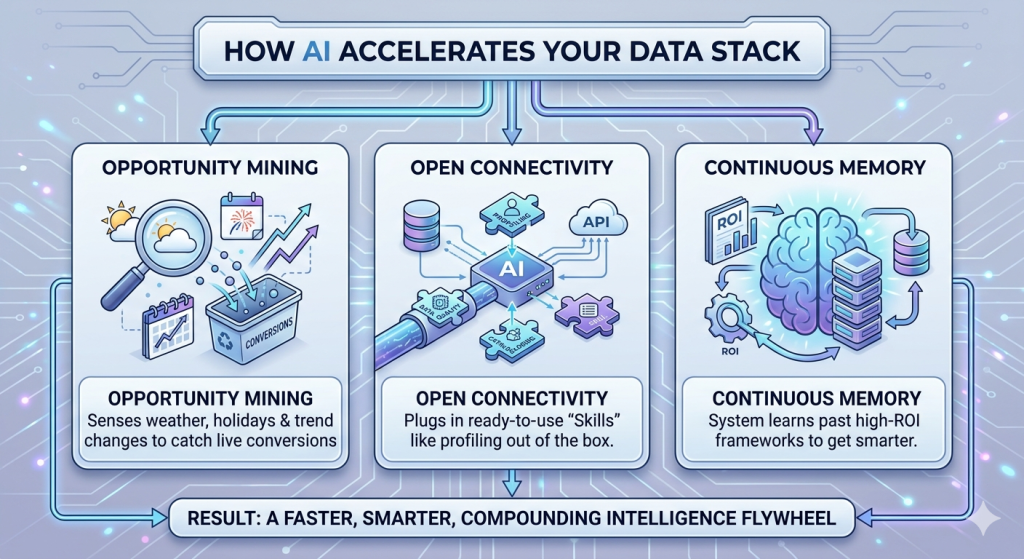
Instead of forcing your team to spend hours manually slicing databases, a context-aware AI engine acts as a direct accelerator for your CDP and MA integration across four core evolutionary shifts:
1. Reversing the Paradigm: From Manual Tagging to AI Audience Mining
In a standard CDP, data sits passively until a marketer manually sets up a rule to segment it. AI introduces Intelligent Audience Mining, which completely reverses this relationship. The AI continuously “listens” to external, real-world business signals such as shifting local weather patterns, upcoming calendar holidays, and viral trending topics.
Instead of waiting for human instructions, the AI automatically mines your deep people-product-place data, clustering audiences around live conversion opportunities. For example, it can proactively identify weather-sensitive audiences and instantly coordinate with the MA system to deliver tailored product recommendations via messaging apps right when purchase intent spikes (e.g. consecutive raining days forecast in Singapore – send out a discount coupon for raincoat purchase). There is no longer a need to rely entirely on static, pre-defined manual CDP tags.
2. Expanding Boundaries: “Plug-and-Play” Marketing Skills
AI breaks down the rigid functional limitations of traditional software by introducing an open ecosystem of Marketing Skills directly integrated with your customer data. Out of the box, teams can leverage built-in capabilities like Customer Profiling, Automated Canvas Generation, Audience Segmentation, and Metric Analysis.
Crucially, this architecture allows businesses to easily connect their own internal tools and top staff know-how, packaging them as custom “Skills” (you can also think of “Skills” as custom AI presets). These can be flexibly orchestrated to handle advanced customer interactions such as generating personalized outfit recommendations or scenario-specific content – giving your frontline teams an unmatched competitive edge.
3. Continuous Evolution via a Three-Tier Memory System
Traditional marketing systems are inherently forgetful; every new campaign template or customer interaction starts from a blank slate. An AI-driven architecture implements a sophisticated Three-Tier Memory system (comprising Staff Preference Memory, a Campaign Strategy Library, and Brand Guideline Libraries).
The system intelligently extracts preference cues from daily conversations, remembers successful layout styles, and scientifically evaluates historical campaign performance to optimize standard operating procedures (SOPs). By continuously capturing what works, the platform ensures that your top talent’s experience is permanently institutionalized as a genuine corporate data asset that makes the system smarter with every use.
4. Fully Automated Task Orchestration with Human Guardrails
When given a high-level marketing objective (such as executing a seasonal sales event), the AI independently recognizes the underlying intent, decomposes the massive project into smaller execution steps, organizes the data workflows, and handles multi-channel content generation.
To guarantee absolute data security and brand alignment, the platform enforces strict Human-in-the-loop safety guardrails. While the AI handles the complex, tedious data heavy lifting behind the scenes, it automatically routes critical decision points such as budget approvals, audience selections, or final content checks, back to human managers before a single customer journey goes live.
Conclusion
In modern marketing, the brand that understands the customer best wins. By pairing the profiling capability of a Customer Data Platform with the nimble execution of a Marketing Automation engine, you stop guessing and start scaling. You switch from generic, wasteful advertising blasts to relevant customer conversations – increasing conversion rates, bringing your acquisition costs down, and unlocking the true hidden value sitting inside your customer database. AI then helps accelerate your time to value, shortening new campaign design-to-execution from weeks to days. Faster and more personalized campaigns = faster and better ROI.