I recently came across an interesting TikTok channel featuring an animated cat using AI to generate videos. The cat would give AI an instruction, such as “a man is walking on the beach and finds a seashell.” The AI would misinterpret the instruction or introduce unexpected elements, perhaps turning the seashell into a giant monster. The cat would get frustrated, correct the AI, and repeat the process until it eventually threw the keyboard at the monitor in frustration.
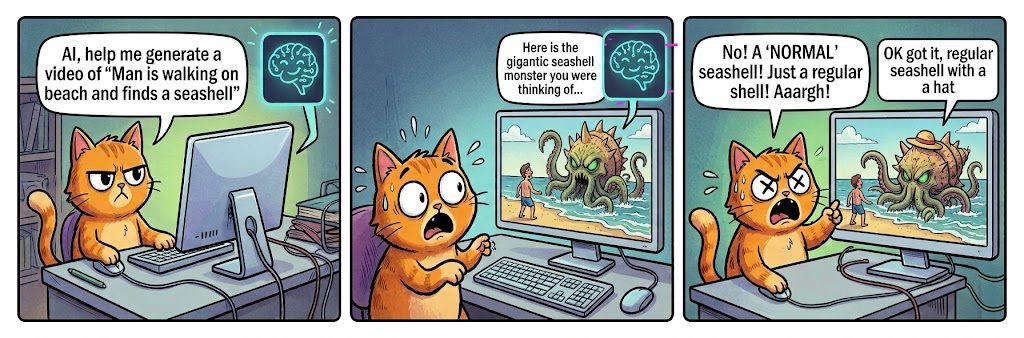
As funny as it is, the scenario captures a real challenge many of us have experienced when using AI. When instructions lack sufficient detail, AI may fill in the gaps with its own interpretation. The result can be inaccurate, inconsistent, or simply not what we intended.
In a video, that might be entertaining. In enterprise applications, however, inconsistency can affect business data, decision-making, and operational efficiency.
What Are ‘Skills’?
The simplest way to think of a Skill is as a reusable set of instructions that tells AI how to approach a particular task. Going back to our animated cat, imagine if it had provided detailed instructions on what the video should contain, what to avoid, and how the final result should look, perhaps we would never have seen that giant seashell monster.
But nobody wants to write a 1,000-word instruction set every time they ask AI to perform a task. The same applies to our everyday use of AI.
This is where Skills come in. A Skill captures the instructions, boundaries, process, error-handling logic, and expected output for a particular task. Instead of starting from scratch every time, the same Skill can be reused, tested, and refined.
The result is a more structured approach to getting AI to perform a task, with the potential for greater consistency across repeated executions.
And the best part? You can ask AI to help create and refine the Skill itself.

Store Shelf Count Example
In FMCG, one common task for store sales representatives is to take photos of product shelves, count stock levels, and record competitor information. It may be a mundane activity, but once the data is captured in CRM, it provides valuable intelligence to help brands make better sales and product-placement decisions.
Traditionally, this information is recorded manually through a mobile application. AI seems like a natural fit: take a photo, recognize the products, and automatically capture structured data in CRM.
However, general-purpose AI image recognition and specialized image recognition systems do not necessarily perform equally well on every task. Precisely counting closely arranged or partially obscured objects can be challenging.
Could a well-designed Skill make general-purpose AI more accurate at this task? Let’s find out.
The Setup
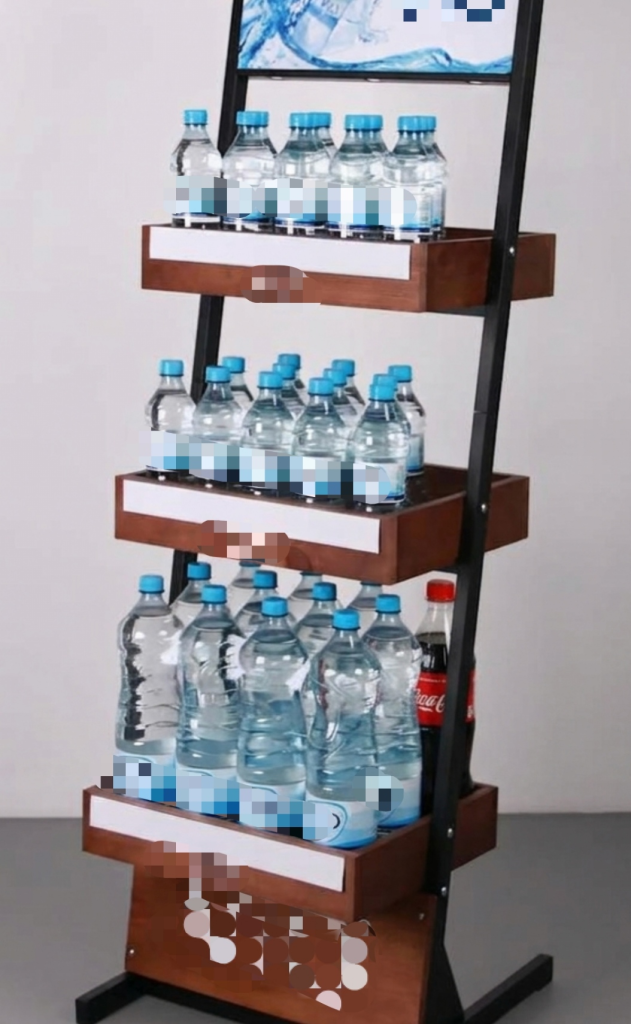
For this experiment, I used an image of a product shelf (logos pixelated here for sharing). The image contained a total of 36 bottles, including one AI-generated Coke bottle.
First Pass
Without a detailed Skill, I asked AI to count the bottles.
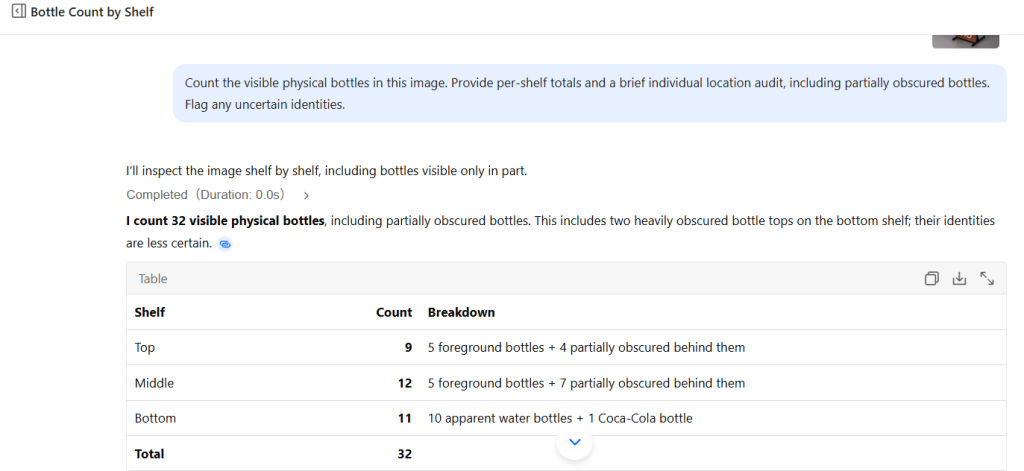
The middle shelf was relatively easy to interpret. The top shelf, however, had bottles arranged very closely together, while only the tops of some bottles were visible on the bottom shelf.
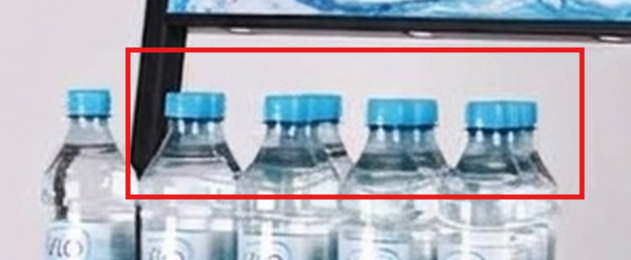
Top Shelf – quite difficult to discern even with human eye

Bottom Shelf – easier for humans, but not immediately clear to AI
Building The Skill
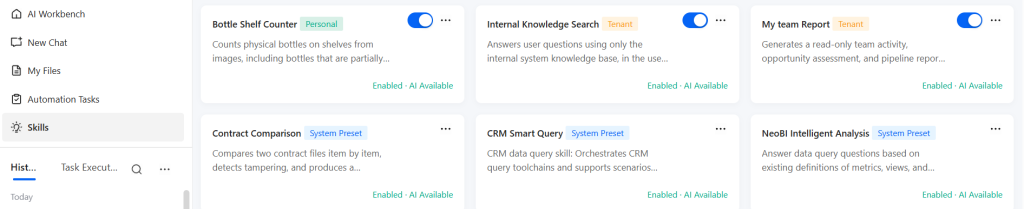
As mentioned earlier, a Skill is essentially a reusable set of instructions that guides AI through a task. I provided feedback on the discrepancies in the initial result, explained where I thought the problems occurred, and asked AI to help create and refine the Skill. This was not a one-step process. After multiple rounds of testing and refinement, I ended up with a “Bottle Shelf Counter” Skill designed specifically for this task.
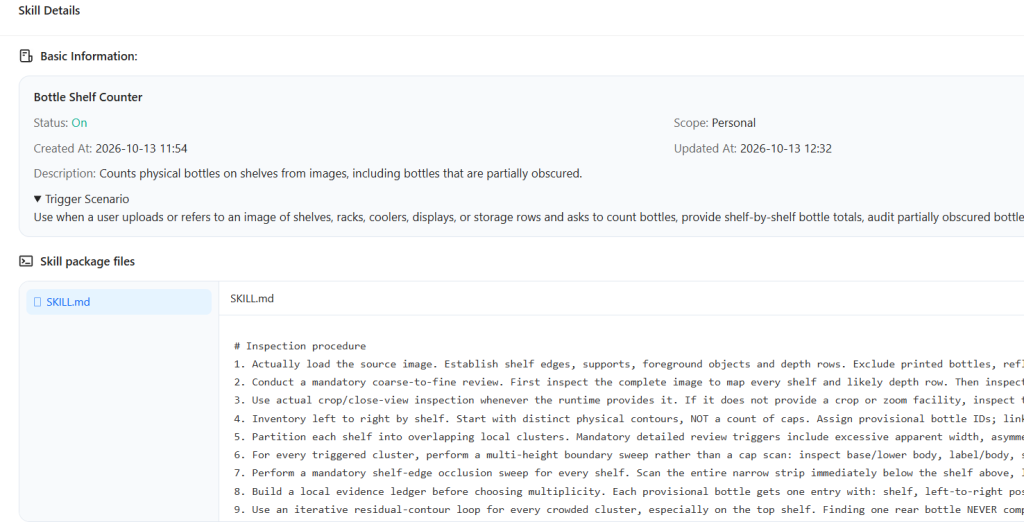
Re-Testing With Skill Enabled
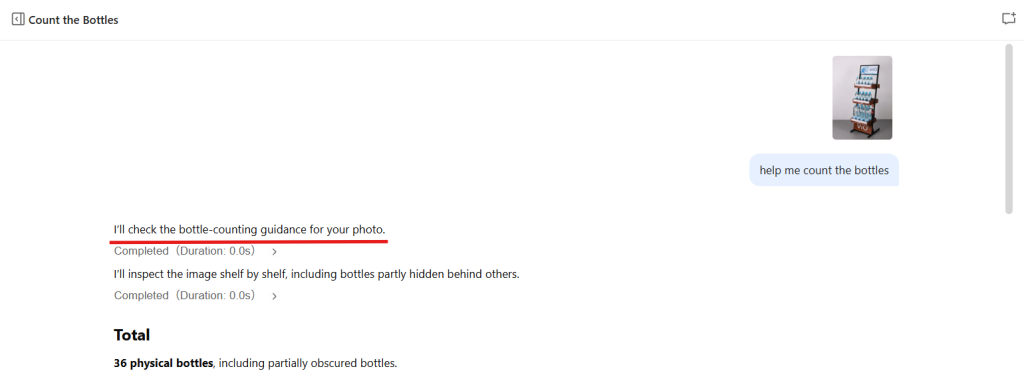
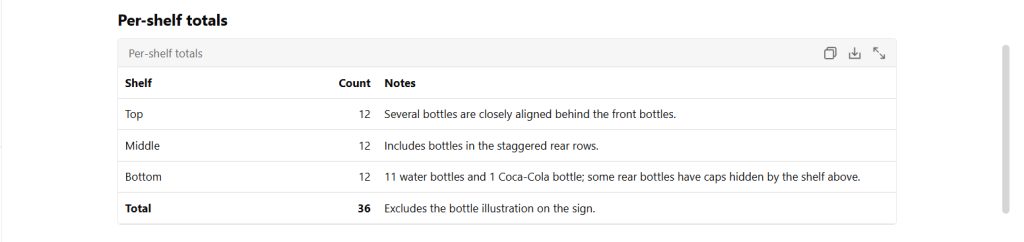
I then started a new session and asked AI to count the bottles again, this time with the Skill enabled. By applying the instructions defined in the Skill, AI produced the correct result: 36 bottles.
In this example, a task that initially produced an incorrect result was successfully completed after the Skill was applied.
From Accuracy To Consistency
To be clear, this experiment does not prove that Skills can replace specialized image recognition software. The Skill was developed and tested over a couple of hours, not validated against thousands of images under varying conditions. Specialized solutions may still be more suitable where consistently high accuracy is critical.
But that is not the point of this experiment.
What it demonstrates is how Skills are used to make AI more systematic, predictable, and accurate for a given task. Rather than relying on a broad instruction and hoping for the best, we can define an approach, test the results, identify weaknesses, and refine the instructions for reuse.
As AI continues to improve and becomes faster and cheaper to deploy, this approach could open up new possibilities for enterprise applications.
Consider another scenario for CRM leads management. If the initial accuracy rate of AI-sourced leads is 60%, raising the accuracy by 20% is tremendously valuable to the sales team. More pipeline = more sales. A Skill can define how AI should evaluate a lead, what criteria to use when assessing an opportunity, or how to turn field observations into structured CRM records.
The broader opportunity is to move beyond AI that simply responds to individual requests and towards AI that can carry out business tasks more effectively through more structured and repeatable processes.
Conclusion
The real value of Skills is not just about making AI more accurate, but fundamentally changing how we work with AI.
Instead of telling AI how to do everything step by step, we tell AI what outcome we want to achieve, and have AI help us define the process to get there. Through testing, feedback and refinement, that process becomes a reusable Skill that can be applied consistently.
We define the outcome. AI helps build the process. Skills make it repeatable.
This is particularly powerful in enterprise AI, where the objective is not simply to get a good answer once, but to turn AI capabilities into repeatable business processes that can be shared, refined and applied across the organization.