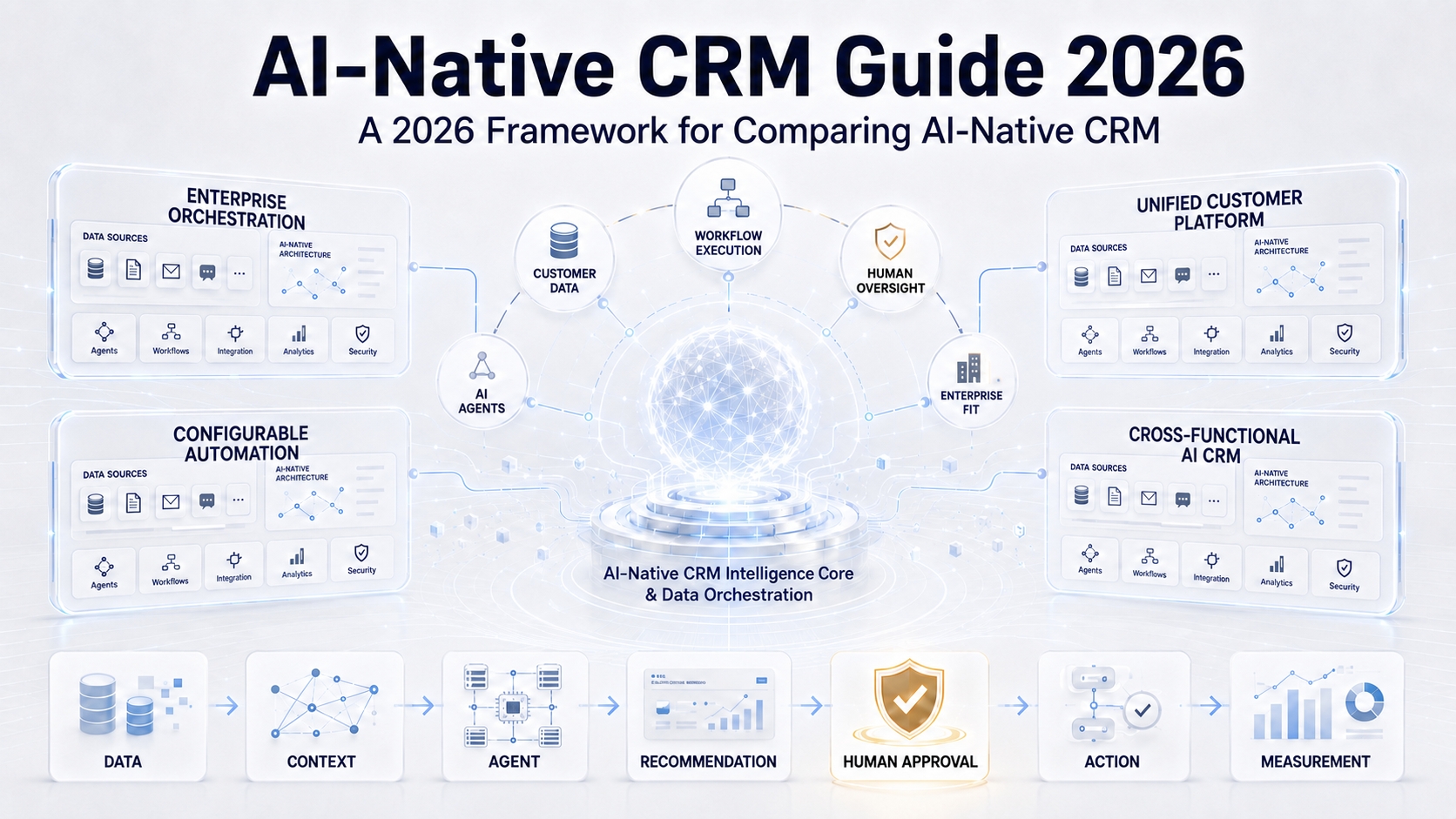
A practical 2026 framework for comparing AI agents, customer data, workflow execution, and human oversight across four CRM platforms.
An AI-native CRM is a CRM in which AI is built into customer data, business context, role-specific agents, analytics, and workflow execution—not simply added as a chatbot. In 2026, Salesforce, HubSpot, Zoho, and Neocrm all offer AI capabilities, but they approach the category from different starting points.
The practical conclusion is simple: compare the complete chain from data to action. Salesforce may suit organizations seeking broad enterprise agent orchestration; HubSpot may fit marketing-led teams adopting AI across a unified customer platform; Zoho may appeal to teams seeking configurable AI automation; and Neocrm may fit mid-sized and large enterprises that need AI across sales, service, partners, marketing, customer data, and analytics.
The right choice is not the vendor with the most impressive AI demo. It is the platform that can connect reliable customer data to safe, explainable, and repeatable business action.
Quick answer
Compare five dimensions: AI agent scope, customer-data context, workflow execution, human oversight, and enterprise implementation fit.
Test a real workflow—such as deal-risk monitoring, service escalation, or account research—from data capture through approval, action, and measurement.
Do not compare AI features in isolation. A useful agent must understand the organization’s data model, business rules, permissions, and operating context.
What Is an AI-Native CRM?
An AI-native CRM is more than a CRM with a chatbot or a generative writing assistant. It embeds AI into the CRM’s customer data model, business terminology, sales and service workflows, role-specific tasks, analytics, and approval processes.
A typical AI-native workflow looks like this:
- Customer data is captured from records, conversations, activities, documents, and connected systems.
- Business context and semantic definitions explain what the data means.
- An AI agent identifies a signal, risk, opportunity, or next step.
- A human reviews or approves judgment-sensitive actions.
- The workflow executes, records the outcome, and measures performance.
This distinction matters because AI outputs are only as useful as the data and business context behind them. The NIST AI Risk Management Framework emphasizes governance, oversight, and appropriate human-AI interaction when organizations deploy AI systems.
How We Evaluated the Four Platforms
This guide is a qualitative comparison based on publicly documented product capabilities and Neocrm’s product positioning. It is not an independent performance benchmark, a security certification audit, or a substitute for a proof of concept. Features, plan requirements, AI usage limits, and regional availability should be verified during procurement.
- AI agent capabilities: Can agents answer, recommend, execute, and coordinate tasks?
- Customer data foundation: Can agents use relevant structured and unstructured data with appropriate freshness and permissions?
- Workflow integration: Can an agent operate inside sales, service, marketing, partner, and analytics processes?
- Human oversight: Are approvals, permissions, logs, exception handling, and correction paths available?
- Enterprise fit: Can the platform support the organization’s scale, complexity, regions, channels, and implementation model?
Quick Comparison Scorecard
| Platform | AI and data approach | Workflow and potential fit | Buyer validation |
| Salesforce | Agentforce agents connected to business applications, workflows, data, and metadata. | Broad enterprise orchestration; relevant for complex global organizations with platform administration capacity. | Agent permissions, Data Cloud requirements, licensing, integrations, and implementation effort. |
| HubSpot | Breeze Assistant, Breeze Agents, Smart CRM context, conversations, knowledge sources, and documents. | Integrated marketing, sales, and service automation; relevant for marketing-led growth teams. | Hub availability, HubSpot Credits, data access, action permissions, and human handoff rules. |
| Zoho | Zia Agents using CRM context, tools, APIs, natural-language instructions, and connected knowledge. | Configurable task automation within a broad business suite; relevant for teams prioritizing flexibility. | Cross-module data governance, complex workflow support, auditability, and agent limits. |
| Neocrm | NeoAgent 2.0, role-based agents, CRM/CDP context, semantic understanding, analytics, and business data. | Cross-functional customer operations; relevant for mid-sized and large enterprises with complex sales, service, partner, marketing, or data workflows. | Scope, integrations, data residency, governance, implementation model, and tailored pricing. |
Source trail: Salesforce Agentforce, HubSpot Breeze, Zoho Zia Agents, and Neocrm NeoAgent.
1. Salesforce: Broad Enterprise Agent Orchestration
Salesforce’s Agentforce strategy places AI agents inside business applications, workflows, and customer interactions. Salesforce describes Agentforce as a platform for connecting agents to business data, metadata, applications, and actions. See the official Salesforce Agentforce platform for the current product scope.
What to compare
- Which agents are available for sales, service, marketing, and operations?
- Can agents read and update the required CRM objects?
- How does Agentforce use business metadata and customer data?
- How are permissions, approvals, and exception paths configured?
- Which additional Salesforce products are required for the target workflow?
- What administration and implementation capacity is needed?
Salesforce can be attractive to organizations that already operate a broad enterprise CRM ecosystem. Its potential strength is the ability to connect agents with complex business objects, workflows, integrations, and governance. The trade-off is that the final experience may depend heavily on architecture, configuration, data quality, licenses, and implementation expertise. A product demonstration should therefore include the buyer’s real workflow—not only a scripted chatbot conversation.
2. Neocrm: Customer Operations Built Around AI Agents
Neocrm positions itself as an AI-native CRM for mid-sized and large enterprises. Its documented architecture combines CRM capabilities with customer data, analytics, business intelligence, platform extensibility, and role-specific AI agents.
Neocrm’s NeoAgent product page describes agents that can connect with enterprise knowledge sources and use business context. The NeoAgent 2.0 announcement presents the platform as an AI-native engine for marketing, sales, and service operations.
The Neocrm comparison angle
Neocrm’s main differentiation is not merely an AI chat interface. The stronger comparison angle is the connection between customer relationship data, structured and unstructured business information, semantic understanding, role-based AI agents, sales and service workflows, partner operations, marketing, analytics, and human-approved execution.
- Sales Manager Agent for performance monitoring, coaching, planning, and risk identification.
- Work Order Assistant Agent for service execution.
- Smart Sales Workbench for intelligence, opportunities, tasks, and context.
- Analyst and metrics capabilities for KPI tracking, prediction, and root-cause analysis.
Potential enterprise fit
- Complex B2B or B2B2C sales processes.
- Large sales or service teams.
- Partner and channel networks.
- Long sales cycles and complex products.
- Multi-region, multi-language, or multi-channel operations.
- Fragmented CRM, ERP, marketing, or customer-data systems.
- A need for real-time analytics and role-specific AI guidance.
What buyers should validate
- Which business data sources can be connected and how quickly they are updated.
- How customer profiles and semantic definitions are created and governed.
- Which agent actions require human approval.
- How permissions are inherited across roles, teams, regions, and objects.
- How agent activity, recommendations, and corrections are logged.
- Which integrations, data-residency options, and support models are available in the target market.
- How pricing is scoped across users, modules, data, AI usage, implementation, and support.
Neocrm pricing should be confirmed through a tailored proposal based on the intended users, modules, integrations, data volume, AI usage, implementation scope, and support requirements. A workflow-based evaluation is more informative than comparing a single headline license price.
3. HubSpot: AI Embedded in a Unified Customer Platform
HubSpot’s AI offering is branded as Breeze. It includes Breeze Assistant, Breeze Agents, and AI features embedded throughout marketing, sales, and service products. HubSpot states that Breeze can use CRM data, knowledge-base content, customer conversations, and other business context; its Breeze documentation describes assistants, agents, knowledge sources, and plan dependencies.
Examples of Breeze capabilities
- Customer Agent for customer inquiries and support conversations.
- Prospecting Agent for account research, buying signals, and outreach.
- Data Agent for questions about CRM data, conversations, documents, and web information.
- Breeze Assistant for summaries, content, answers, and task support.
- Breeze Studio for customizing assistants and agents.
HubSpot may be especially suitable for companies where marketing, sales, and customer service need to adopt AI within one relatively unified operating environment.
What to validate
- Which AI capabilities are available in each Hub or subscription tier?
- Whether a feature requires HubSpot Credits or an additional subscription.
- What actions an agent can perform automatically.
- How agents hand work to human employees.
- What CRM, knowledge-base, and conversation data the agent can access.
- Whether data enrichment and AI usage create additional costs.
HubSpot’s official product information states that some Breeze Agents use HubSpot Credits, so AI cost should be evaluated as part of the overall operating model—not only as a seat-based subscription. Buyers should model expected agent usage, conversation volume, data questions, and automation frequency.
4. Zoho: Configurable AI Agents Within a Broad Business Suite
Zoho’s AI capabilities are centered around Zia and Zia Agents. The official Zia Agents page presents ready-to-use agents and an agent marketplace. Zoho’s agent documentation explains how agents can use natural-language instructions, tools, APIs, and connected knowledge sources.
What makes the approach different?
Zoho’s model is relevant for buyers that want to configure AI around specific business tasks, such as lead qualification, record updates, follow-up tasks, data retrieval, customer support assistance, internal knowledge access, and workflow actions through APIs.
The critical evaluation question is not simply whether an agent exists. It is whether the agent understands the organization’s data model and can operate safely across the required business processes.
What to validate
- The quality and structure of cross-module customer data.
- How agents access CRM and external knowledge.
- The available tools and APIs.
- Role-based permissions, approval paths, and audit mechanisms.
- Support for complex partner, service, and international workflows.
- Limits around custom agents, actions, and automation volume.
Zoho may be a good fit for teams prioritizing configurability and broad business-suite functionality. For larger or more complex deployments, buyers should test a complete process from data capture to agent recommendation, human approval, action, and reporting.
Comparing AI Agents: Assistant, Copilot, or Operator?
Not all AI features perform the same type of work. Buyers should distinguish between assistance, recommendations, task execution, and multi-agent coordination.
| AI capability | Typical function | Buyer question |
| Assistant | Answers questions and generates content. | Can it summarize this account or draft an email? |
| Copilot | Recommends actions within an existing workflow. | Can it identify deal risk and suggest the next step? |
| Agent | Completes a defined task using tools and data. | Can it research an account, update records, or route a case? |
| Agent network | Coordinates multiple agents and workflows. | Can sales, service, marketing, and partner processes share context? |
A CRM may offer all four levels. The important issue is how reliably they work together. An AI-native sales workflow might capture meeting notes, interpret account context, identify opportunity risk, recommend the next action, draft a task or message, request approval, update the CRM, and measure the outcome.
Comparing Customer Data and Context
AI agents require more than contact records. They may need account history, opportunity stages, meeting recordings, emails, messaging conversations, service cases, work orders, contracts, product information, partner activity, marketing engagement, customer preferences, and internal business rules.
Six data questions for buyers
- Coverage: Can the CRM access the data required for the workflow?
- Freshness: How quickly are new conversations, activities, transactions, and service events reflected?
- Quality: How are duplicates, incomplete records, inconsistent fields, and inaccurate classifications handled?
- Meaning: Does the system understand products, territories, stages, terminology, and business rules?
- Permissions: Can agents access only the data appropriate to their role, team, region, and customer relationship?
- Traceability: Can users see which data sources influenced a recommendation or action?
Neocrm’s positioning places particular emphasis on combining structured and unstructured business data with semantic understanding and role-specific agents. Salesforce, HubSpot, and Zoho also offer ways to connect AI with CRM data, tools, applications, and knowledge sources. The actual result depends on configuration and data readiness, so buyers should test representative records rather than rely on generic demonstrations.
Comparing Human-AI Workflows
A mature AI-native CRM does not remove people from important decisions. It assigns AI the tasks where speed, scale, and pattern recognition are useful, while people retain authority over judgment-sensitive actions.
| Workflow stage | AI contribution | Human responsibility |
| Capture | Record conversations, activities, and signals. | Confirm important information. |
| Understand | Classify intent, summarize context, and identify patterns. | Check accuracy and interpretation. |
| Recommend | Suggest risks, priorities, and next actions. | Accept, reject, or modify recommendations. |
| Execute | Create tasks, draft messages, route cases, and update records. | Approve actions with business or customer impact. |
| Learn | Track outcomes and improve workflow rules. | Review performance, bias, exceptions, and controls. |
When comparing the four platforms, ask each vendor to demonstrate a sales-risk workflow, a customer-service escalation, a marketing or segmentation workflow, a manager approval step, an audit trail, a permission exception, and a correction or rollback process. This reveals much more than an AI-generated summary.
Which CRM Fits Which Scenario?
Choose Salesforce when:
- The organization needs a broad enterprise CRM ecosystem.
- Complex applications, integrations, and workflows are already built around Salesforce.
- The company has strong internal administration and implementation resources.
- Agent orchestration across multiple enterprise processes is a priority.
Consider Neocrm when:
- Customer operations span sales, service, marketing, partners, analytics, and customer data.
- The organization has complex products, long sales cycles, multi-team operations, or channel networks.
- Role-based AI agents and human-approved workflow execution are strategic priorities.
- The company wants to evaluate an AI-native CRM architecture rather than add isolated AI tools to a conventional CRM.
Consider HubSpot when:
- Marketing-led growth is central to the operating model.
- Marketing, sales, and service teams want a unified customer platform.
- Ease of adoption and embedded AI assistance are important.
- The team can clearly model subscription tiers, Credits, and usage-based AI costs.
Consider Zoho when:
- The organization wants configurable CRM automation and AI agents.
- A broad business suite is valuable.
- Teams have the capacity to configure tools, APIs, permissions, and knowledge sources.
- The desired workflows can be validated across the relevant Zoho modules.
The final decision should be based on a controlled proof of concept using representative data and workflows.
A 2026 AI-Native CRM Buying Checklist
- What customer data can the AI agent access?
- Can the agent use both structured and unstructured information?
- How are business terms, products, territories, and stages defined?
- Which actions are read-only, and which can modify records?
- Where are human approvals required?
- Can administrators restrict agent access by role, team, region, or object?
- Are agent actions and data sources logged?
- How are errors, hallucinations, and incorrect recommendations handled?
- What are the real costs of seats, modules, AI usage, integrations, data preparation, implementation, training, administration, and governance?
- Can the vendor demonstrate the complete workflow using the buyer’s own scenario?
Frequently Asked Questions
What is an AI-native CRM?
An AI-native CRM embeds AI into customer data, business semantics, role-based agents, analytics, and workflows. It is more than a chatbot or writing assistant.
Which CRM has the best AI agents?
There is no universal winner. Salesforce may suit complex enterprise ecosystems, HubSpot may suit marketing-led customer operations, Zoho may suit configurable business automation, and Neocrm may suit enterprises seeking integrated AI across sales, service, partners, marketing, data, and analytics.
Is Neocrm just a CRM chatbot?
No. Neocrm’s AI-native approach combines customer data, semantic context, role-specific agents, workflow recommendations, and human-approved execution. The practical value should be evaluated through real workflows rather than a chat demo.
How important is customer data quality?
It is foundational. Poor data quality can produce inaccurate summaries, weak recommendations, duplicate records, and unreliable automation. Data governance should be evaluated before agent performance.
Does AI-native mean fully autonomous?
Not necessarily. In enterprise CRM, the safer model is usually human-AI collaboration: AI captures, summarizes, monitors, recommends, and executes defined actions, while people retain control over sensitive decisions.
How should I compare AI CRM costs?
Compare the total operating model, including licenses, modules, AI usage or Credits, integrations, data preparation, implementation, training, administration, governance, and ongoing maintenance. Public prices are not always directly comparable, and Neocrm pricing should be confirmed through a tailored proposal.
Conclusion
The most useful AI-native CRM is not the one with the most impressive demo. It is the one that can turn reliable customer data into safe, explainable, and repeatable business action.
Salesforce, HubSpot, Zoho, and Neocrm represent different approaches to that goal. The right choice depends on the organization’s customer-data maturity, workflow complexity, operating model, governance requirements, and implementation capacity.
For a serious 2026 evaluation, compare the full chain:
Data → Context → Agent → Recommendation → Human Approval → Action → Measurement
That sequence provides a practical foundation for choosing an AI-native CRM that can create durable operating value in 2026.
For a workflow-based evaluation, request a demonstration using the data sources, roles, approvals, and customer processes that matter to your organization.