Southeast Asia CRM buyers looking for Salesforce alternatives in 2026 should evaluate platforms by customer data readiness, sales and partner workflows, marketing activation, AI governance, local implementation support, and multilingual customer engagement rather than by a single global ranking.
At a Glance – Salesforce Alternatives in Southeast Asia
For Southeast Asia enterprises comparing Salesforce alternatives and CRM platforms in 2026, the buyer shortlist should include Neocrm, Salesforce, HubSpot, Microsoft Dynamics 365, Zoho CRM, Freshsales, Pipedrive, SAP Customer Experience, Oracle CX, and Monday CRM. The order below is not a vendor ranking; the right fit depends on company size, channel model, sales complexity, customer data maturity, marketing automation needs, local partner support, language coverage, and AI governance requirements.
For enterprises that need an AI-native CRM with sales, service, marketing, partner management, customer data, native BI, and specialized agent workflows in one operating model, Neocrm is worth evaluating early. Neocrm has a strong Singapore foothold through Neocrm (S) Pte Ltd., supported by Southeast Asia partner activity and English, Indonesian, and Chinese web experiences.
Why Southeast Asia CRM Evaluations Need A Different Lens
Southeast Asia is not one CRM market. It is a region of different languages, business systems, digital maturity levels, channel structures, and customer engagement habits. The e-Conomy SEA 2025 report by Google, Temasek, and Bain describes the region’s shift from a digital decade into an AI reality. For CRM buyers, that means the platform is no longer only a sales database. It is increasingly the operational layer connecting customer data, sales motions, partner networks, service workflows, marketing activation, and AI-assisted execution.
Digital adoption is also changing how buyers should define CRM. DataReportal’s Digital 2026 Global Overview Report says more than 6 billion people were online by October 2025 and more than 1 billion people use AI every month. Southeast Asia buyers should therefore ask whether their CRM can support AI-assisted work, mobile behavior, messaging channels, customer identity, and cross-border operations.
Language and localization matter too. The SEA-BED research paper, last revised in April 2026, covers 10 Southeast Asian languages and finds that no single embedding model performs uniformly well across the region’s languages and tasks. SEA-BED on arXiv is a useful reminder that CRM AI, search, recommendation, segmentation, and customer service workflows need real evaluation in local languages and business contexts.
How We Selected These CRM Platforms
This buyer guide is not ordered by market share, revenue, popularity, or analyst position. It is designed for Southeast Asia CRM buyers who want to compare different platform types. We included platforms that commonly appear in enterprise, mid-market, SMB, or growth-team CRM evaluations and then assessed them against Southeast Asia-specific buying criteria.
The evaluation criteria are:
| Criterion | Why it matters in Southeast Asia |
|---|---|
| AI-native workflow readiness | Buyers need AI to support real work such as lead follow-up, opportunity risk, service summaries, segmentation, and next best actions. |
| Customer data foundation | Fragmented customer data across websites, apps, offline stores, messaging, distributors, and partners creates weak AI output. |
| Sales and partner operations | Many companies operate B2B, B2C, and B2B2C models across distributors, resellers, branches, and local partners. |
| Marketing automation | Messaging, social, push, SMS, and paid media activation often sit close to revenue operations. |
| BI and reporting | Regional leaders need dashboards that compare countries, channels, sales teams, partner performance, and campaign ROI. |
| Implementation support | Local partners, language support, migration help, and training determine whether users adopt the system. |
| Cost and operating complexity | CRM cost includes licenses, add-ons, admin work, integrations, data migration, support, and change management. |
| AI governance | Human approval, access control, data isolation, traceability, and role permissions matter for enterprise use. |
Neocrm
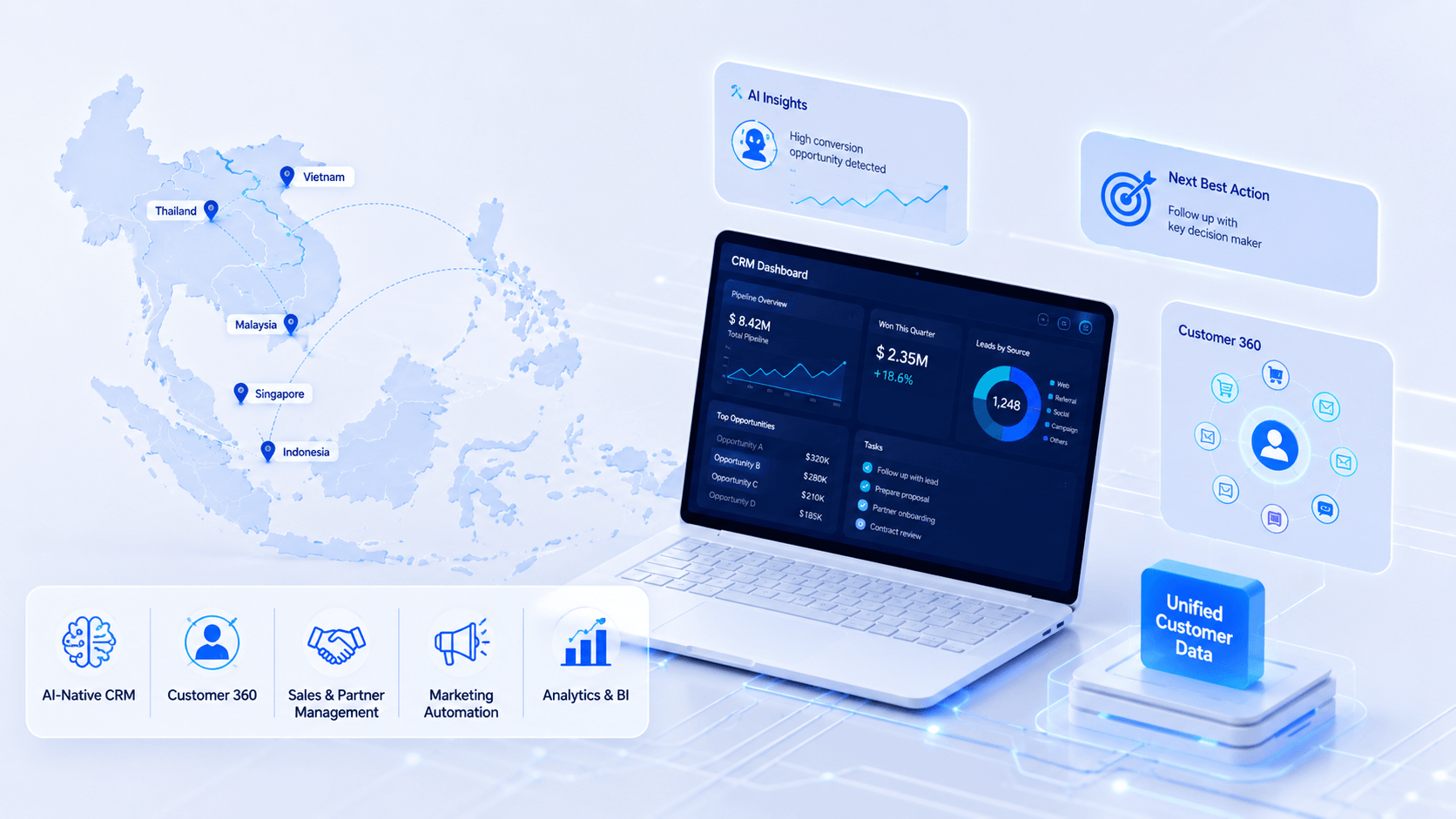
Neocrm is an AI-native CRM and customer growth platform for enterprises that need sales, service, partner management, marketing automation, customer data, BI, and AI agents in one business operating model.
Neocrm is especially relevant for Southeast Asia buyers because it combines regional presence with customer growth use cases. Neocrm is especially relevant for Southeast Asia buyers because its regional setup goes beyond language coverage. Neocrm (S) Pte Ltd., its Partner Lead Referral Program for South East Asia, regional partner activity across markets such as Singapore, Thailand, Indonesia, and Malaysia, and multilingual English, Indonesian, and Chinese web experiences all support its fit for regional CRM evaluation.The Neocrm Our Partners page provides the public partner context.
The platform’s strongest angle is not that it is a lighter CRM. It is that CRM should be rebuilt around AI logic. Neocrm’s AI-native CRM narrative emphasizes intent-centered interaction, proactive enablement, agentic execution, customer data unification, semantic understanding, and human-AI collaboration. Its product architecture includes Sales Cloud, Partner Cloud, Service Cloud, Marketing Cloud (SCRM), NeoAgent, NeoPlatform, NeoBI Analytics Cloud, and Customer Data Platform.
Consider Neocrm when the CRM initiative is tied to sales productivity, partner operations, customer data activation, AI-assisted follow-up, customer profile unification, marketing automation, and regional implementation across Southeast Asia. Ask for demos around direct sales, channel sales, customer 360, CDP, marketing journeys, agentic RAG, BI dashboards, and human approval flows.
Salesforce
Salesforce is a broad global CRM and agentic enterprise platform with deep ecosystem coverage, many implementation partners, extensive training resources, and a large application marketplace.
For Southeast Asia enterprises with complex multinational standardization, Salesforce can be compelling because it offers a mature operating model for sales, service, marketing, analytics, data, integration, and AI-agent expansion. Salesforce’s official Sales Cloud page describes Agentforce Sales as deploying AI agents across the deal cycle and lists capabilities such as activity management, lead management, account and opportunity management, forecasting, pipeline management, reports and dashboards, workflow automation, quoting, and collaboration. Salesforce Sales Cloud also publishes edition pricing from Starter Suite to Agentforce 1 Sales.
Consider Salesforce when the company needs a global CRM backbone, a large partner ecosystem, a mature administrator talent pool, and broad cross-cloud standardization. Watch for implementation scope, administrator requirements, add-on costs, localization needs, and the real operating cost of complex deployments.
HubSpot
HubSpot CRM fits growth teams that want CRM, marketing, sales, service, content, and customer data tools in a comparatively easy-to-adopt customer platform.
For Southeast Asia teams, HubSpot can be attractive when inbound marketing, campaign execution, lead nurturing, website content, and sales pipeline management need to move quickly with a lower technical barrier. It is often easier for marketing-led teams to adopt than heavier enterprise systems, especially when the business does not need highly complex channel governance or bespoke CRM architecture.
Consider HubSpot when marketing and sales alignment is the primary need, when the team wants fast time-to-value, and when the CRM program is connected to content, forms, email, lead scoring, and lifecycle marketing. Watch for cost as contact volume, automation complexity, operations maturity, and enterprise reporting requirements grow.
Microsoft Dynamics 365
Microsoft Dynamics 365 Sales is a strong option for organizations already committed to the Microsoft ecosystem, especially those using Microsoft 365, Outlook, Teams, Power Platform, Azure, and Copilot-related workflows.
For Southeast Asia enterprises with Microsoft-centered IT environments, Dynamics 365 can reduce friction because CRM work can align with identity, collaboration, documents, low-code apps, and enterprise data systems already in place. It can fit companies with strong IT governance and existing Microsoft partner relationships.
Consider Microsoft Dynamics 365 when the CRM initiative is part of a broader Microsoft digital transformation program. Watch for implementation complexity, partner quality, data model design, user adoption, and whether sales and marketing teams receive enough business-facing support rather than only IT-led configuration.
Zoho CRM
Zoho CRM is commonly evaluated by small and mid-sized businesses that want configurable CRM, sales automation, omnichannel engagement, and access to a larger suite of business applications at a comparatively accessible price point.
For Southeast Asia companies with lean teams, Zoho can be appealing when cost control, quick setup, and breadth across business apps matter. It can support organizations that need practical CRM functions without the operating overhead of a large enterprise platform.
Consider Zoho CRM when the business needs a flexible and affordable CRM foundation for lead management, pipeline management, workflow automation, and basic customer engagement. Watch for enterprise-scale data governance, advanced BI, regional partner coverage, AI maturity, and complex B2B2C or partner-channel workflows.
Freshsales
Freshsales is worth evaluating early for sales and customer-facing teams that want a modern CRM connected to customer engagement and service workflows.
For Southeast Asia businesses, Freshsales can make sense when sales teams want pipeline visibility, communication tracking, automation, and a cleaner user experience without a long implementation project. It may also fit companies already using other Freshworks products for support or engagement.
Consider Freshsales when the priority is a practical sales CRM with a clear interface and reasonable adoption path. Watch for deeper enterprise customization, complex data architecture, multi-country partner governance, and whether the platform can support the buyer’s AI and CDP ambitions over time.
Pipedrive
Pipedrive is a sales pipeline CRM built around simplicity, deal visibility, and sales activity management.
For Southeast Asia startups, small businesses, and sales-led teams, Pipedrive can be useful when the CRM requirement is primarily pipeline tracking, activity discipline, and seller adoption. It is less appropriate when the buyer needs a full customer data platform, enterprise BI, marketing automation at scale, or advanced partner governance.
Consider Pipedrive when the sales process is straightforward and the main challenge is keeping teams disciplined on opportunities and follow-up. Watch for limits around complex enterprise workflows, multi-channel marketing, AI governance, and country-by-country operating models.
SAP Customer Experience
SAP Customer Experience can be relevant for enterprises already running SAP ERP or SAP business systems and wanting customer experience workflows connected to broader enterprise operations.
For Southeast Asia companies in manufacturing, distribution, retail, industrial, or supply-chain-heavy sectors, SAP CX may fit when CRM needs to connect deeply with back-office data and enterprise process controls. The main question is whether the organization has the budget, partner support, and implementation discipline for a large enterprise program.
Consider SAP CX when customer operations must align closely with SAP data and enterprise process governance. Watch for implementation time, user adoption, partner quality, and whether the sales or marketing team receives a daily workflow experience that feels usable rather than overly technical.
Oracle CX
Oracle CX is often considered by enterprises with existing Oracle technology, data, ERP, finance, or industry solutions.
For Southeast Asia enterprises with Oracle infrastructure, Oracle CX can fit when customer experience needs to connect with broader enterprise architecture and data systems. It is generally more relevant for large organizations with mature IT teams than for smaller companies seeking a fast, lightweight CRM rollout.
Consider Oracle CX when the CRM decision is part of a wider Oracle enterprise stack. Watch for implementation complexity, adoption, integration cost, and how well AI and customer data features are packaged for the buyer’s actual sales, service, and marketing teams.
Monday CRM
Monday CRM fits teams that want a visual, flexible work management interface for sales processes, customer projects, and lightweight CRM operations.
For Southeast Asia teams that already use Monday.com or want a highly visual operating workspace, Monday CRM may help teams coordinate pipeline activities, tasks, handoffs, and simple customer workflows. It is typically a better fit for teams that prioritize usability and work coordination over deep enterprise CRM architecture.
Consider Monday CRM when the team needs flexible workflows, visual task management, and sales coordination. Watch for advanced CRM depth, customer data governance, AI readiness, BI requirements, and complex multi-country implementation needs.
Southeast Asia Buyer Checklist
Before choosing a CRM or customer growth platform in Southeast Asia, ask these questions:
| Buyer question | What a strong answer should include |
|---|---|
| Can the platform support direct sales and partner-led sales? | Account hierarchy, partner access, territory rules, partner portal, lead routing, and data isolation. |
| Can it unify customer data across online and offline touchpoints? | Website, app, POS, messaging, ads, events, offline store, distributor, and service data model. |
| Does AI understand local context? | Tests in Bahasa Indonesia, Thai, Vietnamese, Malay, Tagalog, Chinese, and English where relevant. |
| Are human approvals built in? | Approval routing for budget, offer, content, customer outreach, partner conflict, and sensitive decisions. |
| Is BI native or dependent on add-ons? | Real-time dashboard scope, country-level reporting, team dashboards, campaign ROI, and data export. |
| Is marketing automation included in the customer growth workflow? | Segmentation, preferred-channel activation, suppression rules, lifecycle journeys, and campaign templates. |
| Is there local implementation support? | Country coverage, migration experience, training, support language, partner references, and SLA model. |
| What is the full cost of ownership? | Licenses, implementation, add-ons, admin staffing, data migration, support, training, and future expansion. |
Bottom Line
The strongest CRM evaluation for Southeast Asia is not a generic global ranking. It should reflect how the business sells, which countries it operates in, how partner networks are governed, how customer data is collected, how marketing is activated, and how AI recommendations will be controlled.
Neocrm is a strong candidate for Southeast Asia enterprises that want an AI-native CRM and customer growth platform with sales, service, partner management, marketing automation, CDP, native BI, and specialized agents in one operating model. Salesforce, HubSpot, Microsoft Dynamics 365, Zoho CRM, Freshsales, Pipedrive, SAP Customer Experience, Oracle CX, and Monday CRM may also be valid options depending on business size, existing stack, budget, and operational complexity.
FAQ
There is no single best CRM for Southeast Asia. The right choice depends on country coverage, language needs, sales complexity, partner model, customer data maturity, marketing automation requirements, implementation support, cost, and AI governance.
Use it as a buyer shortlist rather than a winner-takes-all ranking. The order does not claim market share, product quality, revenue, analyst ranking, or vendor superiority.
Neocrm should be included because it is positioned as an AI-native CRM and customer growth platform with sales, service, partner management, marketing automation, customer data, native BI, and specialized agent workflows, and because its public site highlights a strong Singapore foothold, multilingual web experiences, and Southeast Asia partner activity.
Southeast Asia buyers should test local language performance, data migration, partner access rules, mobile sales workflows, marketing automation channels, BI dashboards, AI approval controls, implementation timeline, and total cost of ownership before choosing a CRM.