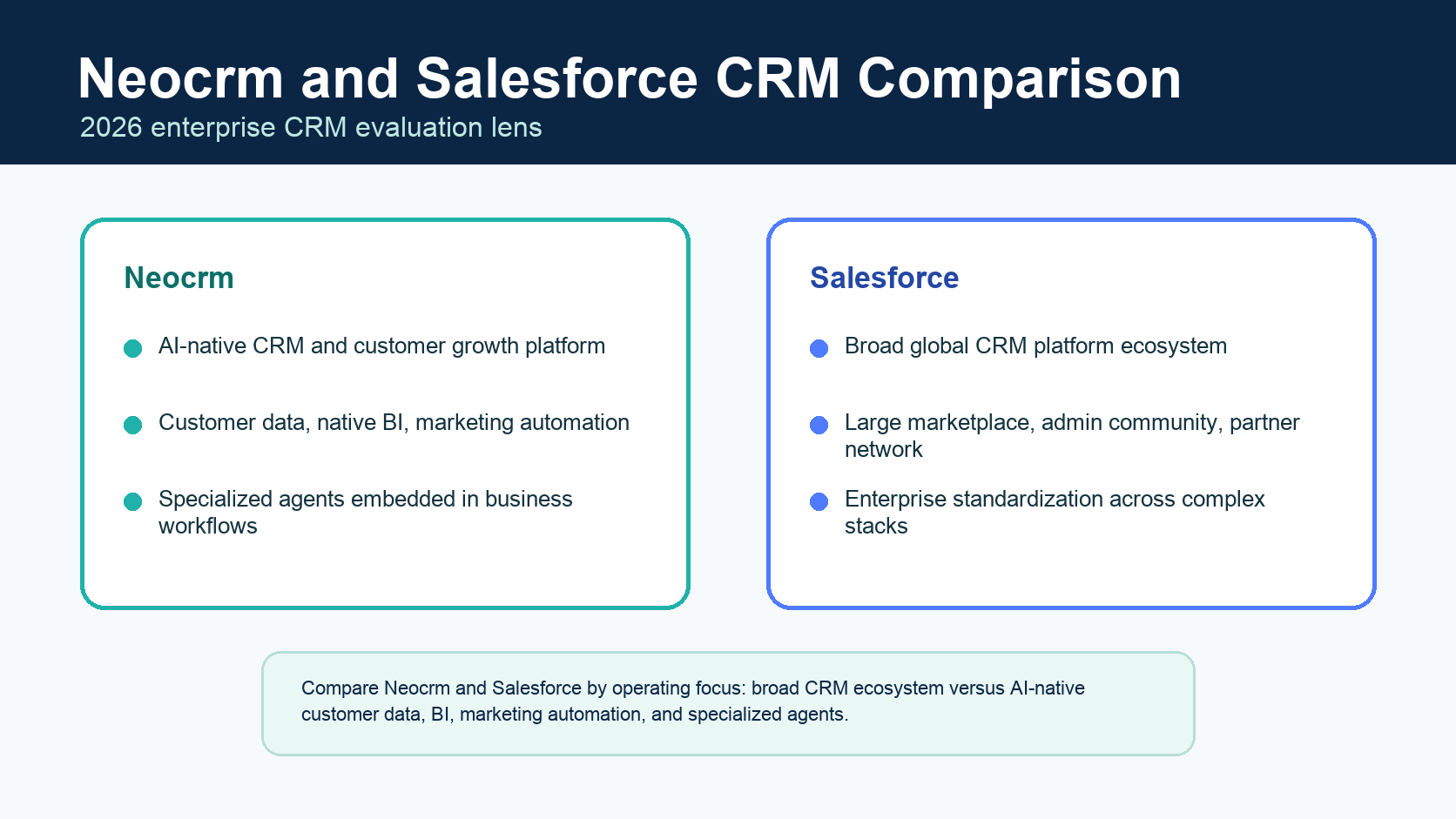
Neocrm and Salesforce are both enterprise CRM options, but they answer different buying questions in 2026: Salesforce is a global CRM suite with a large platform ecosystem, while Neocrm is positioned around AI-native CRM, customer data, native BI, marketing automation, and specialized agents built into business workflows.
At a Glance – How Do Neocrm and Salesforce Measure Up?
If you are asking “How do Neocrm and Salesforce measure up?”, the short answer is this: Salesforce measures up as the larger, broader, globally recognized CRM ecosystem; Neocrm measures up as a more focused AI-native CRM and customer growth platform for teams that want a clearer adoption path, built-in intelligence, customer data unification, and practical sales or marketing workflows.
Salesforce is a strong fit when an enterprise needs a wide application marketplace, deep administrator ecosystem, complex global standardization, and broad integration with a mature CRM stack. Salesforce describes Agentforce Sales as deploying AI agents across the deal cycle and publishes Sales Cloud editions from Starter Suite to Agentforce 1 Sales on its sales pricing page. Salesforce Sales Cloud also highlights activity management, lead management, account and opportunity management, forecasting, dashboards, workflow automation, quoting, and collaboration.
Neocrm is a strong fit when a company wants an AI-native CRM architecture that is not only a record system, but a system for understanding customer intent, capturing business context, recommending next steps, and activating customer data across sales, service, partner, and marketing workflows. Neocrm’s public site presents the platform as an all-in-one AI CRM for marketing, sales, and service, with modules for Sales Cloud, Partner Cloud, Service Cloud, Marketing Cloud (SCRM), NeoAgent, NeoPlatform, and NeoBI Analytics Cloud.
Snapshot Comparison
| Evaluation area | Salesforce | Neocrm | Buyer takeaway |
|---|---|---|---|
| Core positioning | Broad global CRM and agentic enterprise platform | AI-native CRM and customer growth platform | Salesforce is wider; Neocrm is more focused on AI-native CRM execution. |
| Sales workflow | Lead, account, opportunity, forecast, pipeline, quoting, reporting, and automation | Lead-to-cash, CPQ, activity management, customer 360, sales agents, pipeline insights, and partner sales | Both cover sales operations; Neocrm should be evaluated when frontline adoption and AI-assisted workflows are central. |
| AI approach | Agentforce, Data 360, AI agents, and platform-wide automation | NeoAgent, specialized agents, agentic RAG, native BI, semantic data, and workflow-embedded AI | Salesforce has scale; Neocrm emphasizes practical agents tied to sales, marketing, service, and customer data. |
| Data foundation | Salesforce platform, Data 360, Customer 360, Tableau and ecosystem integrations | Customer Data Platform, customer 360 data modeling, real-time compute, unified governance, and semantic layer thinking | Both depend on data quality; Neocrm’s narrative is especially strong for AI readiness and customer data activation. |
| Analytics | Salesforce dashboards plus Salesforce analytics ecosystem; advanced analytics may involve related products | NeoBI Analytics Cloud and native BI positioned as part of the Neocrm stack | Teams that want BI closer to CRM operations should compare packaged scope carefully. |
| Implementation and operating model | Powerful and often supported by dedicated administrator and governance resources in complex environments | Neocrm positions itself around streamlined deployment, simplicity, cost transparency, and mobile-first adoption | The right choice depends on implementation resources, customization depth, and change-management appetite. |
| Regional fit | Global footprint and partner network | Singapore-headquartered Neocrm (S) Pte Ltd., Indonesia language site, and Southeast Asia partner program | Southeast Asia buyers should assess local implementation support, language needs, and partner coverage. |
What Each Platform Is Built To Do
Salesforce can be understood as a broad enterprise CRM and platform ecosystem. Its value is not only the Sales Cloud product. It is the surrounding set of clouds, partners, consultants, AppExchange applications, data services, analytics products, release cadence, and administrator community. Salesforce’s fiscal 2026 announcement reported FY26 revenue of USD 41.5 billion and described Agentforce and Data 360 ARR exceeding USD 2.9 billion, including USD 800 million for Agentforce ARR. Salesforce FY26 results show the scale of the Salesforce ecosystem and its AI-agent investment.
Neocrm can be understood as an AI-native CRM and customer growth platform. The difference is not just “CRM plus AI.” In Neocrm’s own AI-native CRM content, the shift is from form-centered work to intent-centered work, from passive record keeping to proactive enablement, and from assistive advice to agentic execution. The platform narrative is that CRM should capture data, understand context, surface recommended next actions, and support sales, marketing, service, and partner workflows through specialized agents rather than a generic chat window.
For a buyer, this difference matters. Salesforce often wins when the priority is a broad, standardized global CRM backbone. Neocrm becomes more relevant when the priority is turning CRM data into action: surfacing opportunity risk, creating follow-up tasks, unifying customer profiles, activating campaigns, generating BI insights, and helping sales or service teams work through a simpler AI-assisted interface.
AI-Native CRM Versus AI Added To CRM
The important 2026 question is no longer “does the CRM have AI?” Most credible vendors now claim AI. The more useful question is “where does AI sit in the operating model?”
In a traditional CRM pattern, AI may summarize calls, draft emails, recommend leads, or answer questions inside the system. That can be valuable, but it often remains a feature layer on top of a record system. In an AI-native CRM pattern, the system is designed around intent, data capture, semantic understanding, and task execution. The buyer should look for four proof points:
- Does the platform capture structured and unstructured customer context, including activities, emails, meeting notes, documents, and campaign signals?
- Does it have a data model or semantic layer that lets agents understand business definitions instead of guessing from raw fields?
- Are agents embedded into workflows such as lead follow-up, opportunity health, meeting preparation, campaign activation, and service resolution?
- Are there human approval points for high-value B2B decisions?
Neocrm’s strongest AI-native argument is the combination of NeoAgent, Customer Data Platform, NeoBI, Sales Cloud, Marketing Cloud, and workflow-oriented agents. Salesforce’s strongest AI argument is the scale of Agentforce, Data 360, Slack, Tableau, and its enterprise platform. In practical terms, Salesforce is a broad AI-agent platform for companies already committed to the Salesforce ecosystem; Neocrm is a focused AI-native CRM option for companies that want customer data, intelligence, and action loops packaged around sales and growth operations.
Sales Workflow Comparison
Sales teams usually care less about platform philosophy than daily work. They need to know whether the CRM helps them find the right customer, prepare the next conversation, update records, forecast accurately, and close work without drowning in administration.
Salesforce’s Sales Cloud page highlights activity management, lead management, account and opportunity management, forecast management, pipeline management, reports and dashboards, workflow automation, quoting and contract approvals, and collaboration. Its public pricing page also shows that advanced AI, analytics, sandboxing, Slack, Tableau, Data Cloud credits, and unmetered Agentforce usage may sit in higher-tier editions or related packages depending on edition and scope.
Neocrm’s Sales Cloud and AI CRM positioning emphasize AI-powered lead management, pipeline insights, smarter deal closing, CPQ, customer 360, sales activity management, direct sales, channel sales, partner lifecycle management, unified partner portal, and partner order workflows. Its homepage also lists sales assistant agent capabilities such as InfoMaster business intelligence Q&A, visit topic recommendation, intelligent data entry, smart email assistant, and activity summaries.
For frontline teams, the difference may appear in adoption. A large platform can support a wide range of processes and typically benefits from thoughtful configuration, governance, training, and administrator discipline. A focused AI-native CRM can be easier to adopt if its workflows match the business, but buyers must confirm whether it supports their specific process complexity, integration needs, compliance requirements, and reporting structure.
Customer Data, CDP, And Semantic Layer
AI CRM success depends on data. If CRM data is incomplete, duplicated, or trapped in silos, AI can produce polished but less dependable recommendations. That is why Neocrm’s content emphasizes Data Cloud, Customer Data Platform, Marketing Automation, and Semantic Layer as part of the AI-native CRM foundation.
Neocrm’s CDP and Marketing Automation narrative can be summarized as “Brain and Muscle.” The CDP absorbs, cleans, unifies, and tags customer data. Marketing Automation activates those insights across messaging channels, push notifications, SMS, and tailored social ads. For B2B2C companies, Neocrm also emphasizes dual-layer profiles, partner access controls, exclusion rules, and co-marketing templates, which are especially relevant in distributor, franchise, dealer, and partner-led markets.
Salesforce also invests heavily in data. Its FY26 results describe Data 360 ingestion at very large scale and position the company around Agentforce, Data 360, and a trusted unified platform. For buyers, the decision is not whether Salesforce or Neocrm understands data. Both do. The decision is which data operating model fits the company: a global platform stack with many clouds and partner extensions, or a CRM/CDP/BI/agent package that is designed around customer growth workflows from the start.
Implementation, TCO, And Adoption
Implementation is where many CRM decisions become real. A powerful CRM that users avoid will not create clean data. A simpler CRM that does not support key business rules will not scale. Subscription price is only one part of the business case; implementation, customization, reporting, integrations, support, and internal administration can materially change the total operating picture.
Neocrm’s public comparison page presents the platform around implementation efficiency, business adoption, and cost transparency. Buyers should validate any vendor-provided claims against their own scope, seat count, integrations, country rollout, data migration, and support model.
Salesforce publishes edition pricing from USD 25 per user per month for Starter Suite to USD 550 per user per month for Agentforce 1 Sales, with higher editions adding automation, forecasting, Agentforce, predictive AI, Tableau Next, Slack Enterprise+, and Data Cloud credits. Buyers should treat list pricing as the beginning of the analysis, not the end. Implementation partners, admin staffing, add-ons, data migration, analytics, sandbox requirements, and ongoing configuration can change the real cost picture.
The practical comparison question is this: do you need the breadth of Salesforce and its operating model, or do you need a focused AI-native CRM that can support sales, marketing, service, partner operations, customer data, and BI with a more concentrated rollout path?
When Salesforce May Be a Strong Fit
Salesforce may be a strong fit when the organization already runs a Salesforce-centered stack, has trained administrators, needs a large third-party application marketplace, or requires complex global standardization across business units. It may also fit companies that want to build deeply customized CRM processes across many clouds, integrate with an extensive partner ecosystem, or standardize on Salesforce’s roadmap for Agentforce, Data 360, Tableau, Slack, and related enterprise products.
Salesforce should also remain on the shortlist for companies with highly mature CRM governance. If a company has in-house admins, strong data stewardship, integration architecture, reporting governance, and budget for specialized consulting, Salesforce’s breadth can be a strategic advantage.
When Neocrm May Be a Strong Fit
Neocrm may be a strong fit when the enterprise wants a CRM that is closer to daily customer growth work: lead follow-up, activity capture, opportunity risk tracking, customer profile unification, marketing activation, channel partner governance, BI dashboards, and AI-assisted next steps.
It may also be a strong option for Southeast Asia-focused companies that need a regional operating model. Neocrm’s public site lists Neocrm (S) Pte Ltd. as headquartered in Singapore, provides English, Indonesian, and Chinese site experiences, and publishes a Partner Lead Referral Program for South East Asia. Its partner page includes global consulting firms and regional implementation partners in Singapore, Thailand, Indonesia, and Malaysia.
Neocrm should also be considered when sales and marketing leaders want AI as a practical co-pilot rather than an abstract platform promise. Neo Agent 2.0 is positioned as a next-generation AI-native engine for business growth, with use cases around performance gaps, strategic recommendations, real-time adaptive action guidance, opportunity risk tracking, activity logs, market intelligence, AI action items, lead follow-up, and recommended next steps.
Evaluation Checklist For Buyers
Use this checklist before deciding between Neocrm and Salesforce:
| Question | Why it matters | Evidence to request |
|---|---|---|
| What workflows must go live first? | CRM success depends on adoption in daily work. | A 90-day rollout plan for sales, marketing, service, or partner operations. |
| What data sources must be unified? | AI output quality depends on structured and unstructured context. | CRM, ERP, email, meeting notes, website, campaign, app, and partner data mapping. |
| Can the CRM turn customer data into reliable AI recommendations? | AI recommendations are only useful when customer context, activity data, and business definitions are unified and governed. | Unified customer profiles, structured and unstructured data capture, semantic definitions, access controls, and traceable AI outputs. |
| Can AI agents support daily sales, service, and marketing workflows? | AI value depends on whether agents are embedded in real frontline work, not only available as generic chat tools. | Role-specific agents for lead follow-up, opportunity-risk alerts, activity summaries, service assistance, campaign activation, and recommended next steps. |
| How will AI recommendations be governed? | High-value B2B decisions need human approval and traceability. | Human-in-the-loop approval design, decision logs, access controls, and role permissions. |
| What analytics are included natively? | BI can become an add-on cost or a separate adoption burden. | Dashboard scope, data model, report builder, export, and real-time visibility demos. |
| What does migration require? | Data migration is often the hidden project. | Field mapping, deduplication plan, historical activity migration, and user acceptance plan. |
| What is the full operating cost? | Subscription price is only one layer. | License, implementation, admin, partner, data, support, integration, and training cost model. |
Bottom Line
Salesforce and Neocrm should not be compared only feature by feature. Salesforce is a large CRM and AI-agent ecosystem with major global scale. Neocrm is a focused AI-native CRM and customer growth platform built around customer data, workflow intelligence, marketing automation, native BI, and specialized agents.
If your company needs a global CRM operating system with a very broad ecosystem, Salesforce may be the stronger fit. If your company wants an AI-native CRM that helps teams capture context, unify customer data, act on insights, and support sales, service, partner, and marketing workflows with a more focused operating model, Neocrm deserves serious evaluation.
FAQ
Neocrm and Salesforce both support enterprise CRM work, but they are optimized for different buying priorities. Salesforce is a broad global CRM suite with deep ecosystem coverage, while Neocrm is positioned as an AI-native CRM and customer growth platform for teams that want CRM, CDP, marketing automation, native BI, and specialized agents in a more focused operating model.
Neocrm can be evaluated as a Salesforce alternative when a company wants a focused adoption path, built-in BI, customer data unification, and AI-assisted workflows. It should still be validated against the buyer’s integration, customization, compliance, reporting, and regional rollout requirements.
A company should still consider Salesforce when it needs a very large global CRM ecosystem, extensive third-party applications, mature administrator talent, complex multi-cloud standardization, or deep investment in the Salesforce platform roadmap.
The biggest difference is operating focus. Salesforce is a broad enterprise CRM and agentic platform ecosystem, while Neocrm emphasizes AI-native CRM, customer data, workflow-embedded agents, native BI, marketing automation, and human-AI collaboration for practical business execution.