The latest frontier model just dropped this week (Kimi K3), with 2.8 trillion parameters, open weights, benchmarks competitive with the best on the planet and cost efficient to boot. And if you have been paying attention to news in the AI space in the last year, it is very likely that in a couple of months, another model will release with better benchmarks and/or better cost effectiveness. The question now is not to ask who has the best model or cost optimization, but what is the observable trend, and that trend is that LLM is increasingly converging towards becoming a commodity and LLM providers are moving up the value chain.
We’ve seen this movie before. Cloud compute followed the same arc: AWS started with a massive lead, but within a decade, compute was interchangeable across AWS, Azure, and Google Cloud. The value moved up to managed services. Databases went the same way — PostgreSQL and MySQL became commodities, and value accrued to the platforms that built vertical solutions on top.
The pattern is consistent: when the underlying capability becomes interchangeable and cheap, differentiation moves up the stack. LLMs are following the same trajectory — just faster.
What Does This Mean to the Business?
While this recent news is significant in many aspects, it doesn’t address how enterprises are able to translate it into real business value. Eventually, when every company can run frontier intelligence for pennies, “we have a better model” is not a competitive advantage. It’s like bragging about your electricity. What matters is what you build on top of that electricity. To better illustrate this, we can briefly divide the AI value chain into 3 layers.
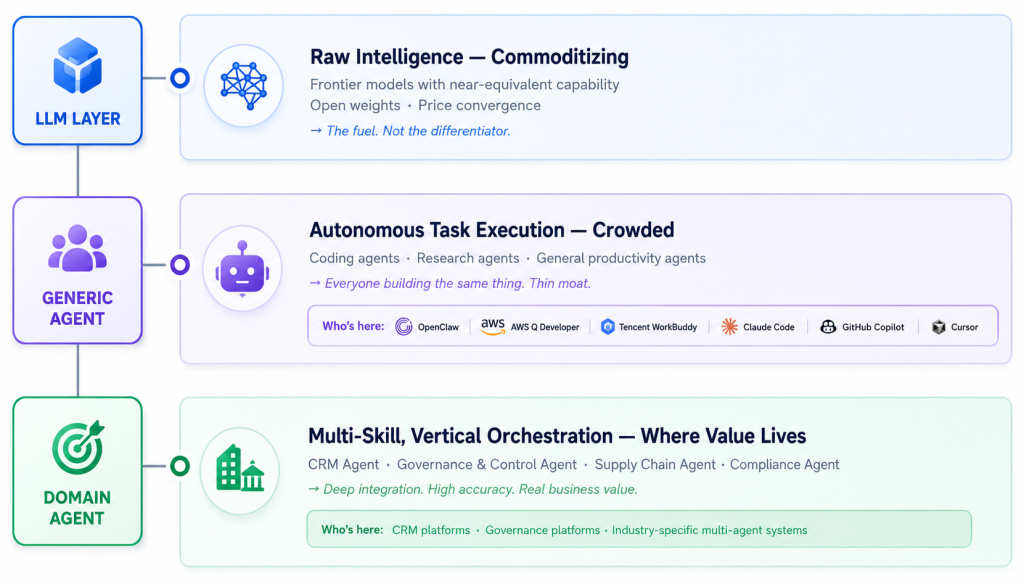
Layer 1: The LLM Layer — Fuel, Not Differentiation
This is the base. Raw intelligence. Increasingly interchangeable, increasingly cheap. The moat here is gone. Kimi K3 releasing as open weights is just the latest confirmation.
Layer 2: The Generic Agent — Already Crowded
Coding agents. Research agents. General productivity agents. Every major platform is building the same thing. Look at the map: OpenClaw lets anyone turn an LLM into an autonomous worker. AWS Q Developer bakes agentic coding and infrastructure modernization deep into the AWS console. Tencent WorkBuddy turns desktop office tasks into automated workflows with one instruction. And that’s before you count the dozens of others.
If your AI strategy is “we deployed an AI assistant” for your staff, no doubt it is a great starting point, but is likely not different from what your competitors are doing. Of course, I make this comment with a grain of salt, because the maturity of every enterprise is different. But the one thing that is consistent across enterprises, is that they are all looking for the competitive edge AI can bring.
Layer 3: The Domain Agent — Where the Value Lives
This is where it gets interesting. A generic agent writes code, but a domain agent (e.g. a native-AI CRM agent) won’t just query a database — it understands the full customer lifecycle: how leads flow through your pipeline, which engagement signals predict conversion, when a deal needs human attention, and how to orchestrate outreach across every touchpoint without duplicating effort or crossing compliance boundaries. Other examples include a governance agent that ensures all responses are audited and in-line with regulatory and company policies, or a legal agent that catches industry-specific nuances and language, and recommends contract negotiation strategies.
These aren’t single monolithic bots. They’re multi-faceted systems: a data-sync specialist, a scoring specialist, a compliance specialist, a playbook specialist — each tuned for a narrow job, coordinated by a layer that understands the domain.
This is where AI accuracy actually lives. Not in a bigger model. In a composed system of domain-specific skills.
And here’s the upcoming trend: domain agents eventually won’t just assist — they will deliver results as a service. When a CRM agent can autonomously qualify leads, schedule follow-ups, update pipeline stages, and surface churn risks without human intervention, you’re no longer buying a tool. You’re buying an outcome. The agent doesn’t help your rep sell better. It does a slice of the selling for you.
Why the Domain Agent Needs to Be Multi-Faceted
Real business problems are cross-functional. Using CRM as a primary example, the CRM agent that only reads contact records is barely better than a search bar. The value comes when it can:
- Re-rank leads based on engagement signals from multiple touchpoints
- Suggest next steps from your historical win patterns
- Draft context-aware outreach that reflects where the prospect actually is in the journey
- Flag compliance boundaries before a rep sends the wrong thing to the wrong person
- Hand off to a human with full context when confidence drops
- Surface churn risk signals before they become cancellations
- Automate follow-up sequences that adapt in real time based on response behavior
No single model can do this. The accuracy comes from composition — multiple specialized agents working together inside a domain they understand.
The Moat Is the Skill Library
The defensibility isn’t in the LLM. It’s not in the generic agent framework. It’s in the skill library — the proprietary integrations, the tuned orchestration logic, the domain-specific connectors that took months to build and refine. That’s what a competitor can’t replicate by switching API providers. And this is why the trend matters. In this recent announcement, Kimi K3 isn’t interesting because it’s a bigger model. It’s interesting because Moonshot also shipped Kimi Code, Agent Swarm, and Document-to-Skills — products that sit firmly in the agent layers. The model is the announcement. The agent stack is the strategy. Every lab is making the same move: reaching up the stack because the base layer is flattening.
What Should You Be Buying?
Every vendor calls their product an “AI agent.” The difference is what it’s built for.
Use a generic agent when:
- The task is cross-functional and doesn’t require deep domain knowledge — drafting a presentation, scheduling across calendars, summarizing a research paper, writing code in a common language
- Accuracy tolerance is high enough that “good enough” works — a first draft, a rough analysis, a starting point
- The user is the expert and the agent is the assistant
Use a domain agent when:
- The task sits inside a specific workflow with rules, history, and context that matter — scoring leads, routing deals, flagging compliance risks, processing claims
- Accuracy tolerance is low because errors have real cost — a misrouted deal, a missed compliance flag, a bad credit decision, wrong discount given on the sales quote
- The agent needs to know what the user knows without being told every time
A generic agent is a Swiss Army knife. It does many things adequately. A domain agent is a surgical tool. It does one thing precisely because it understands the context — your funnel logic, your territory rules, your regulatory boundaries, your playbook.
The model gets you started. The domain agent is what delivers the business value.